Clios Review: Manga's First Century
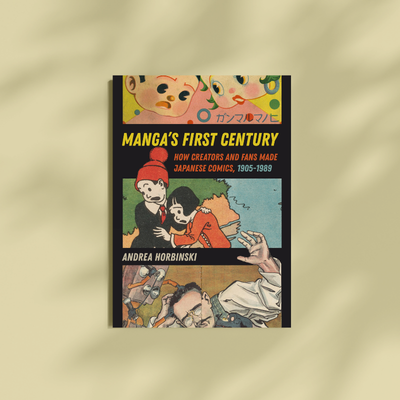
Andrea Horbinski, Manga’s First Century: How Creators and Fans Made Japanese Comics, 1905–1989 (University of California Press, 2025).
Andrea Horbinski’s Manga’s First Century: How Creators and Fans Made Japanese Comics, 1905–1989 tells the history of one of the world’s most influential forms of popular culture. Significantly, Horbinski argues that it was not creators or studios alone who made manga what it is today, but also generations of manga fans. That emphasis on fandom is one of the book’s great strengths. Horbinski shows that readers were never simply passive consumers. Whether lobbying for more of their favorite comics, establishing pathways from fandom to profession, or forming communities that increasingly made space for experimentation outside mainstream publishing, fans have played a key role in keeping manga alive and flourishing. Ultimately, they helped push the medium in directions the professional industry did not always anticipate.
Along the way, Horbinski traces the evolution of manga through children’s comics, gekiga, shōnen and shōjo manga, Boys’ Love, anime, and the growing world of amateur production. Osamu Tezuka, the celebrated creator of Astro Boy and so-called “God of Manga,” receives considerable attention, but Horbinski complicates the familiar story of his influence. She places Tezuka within a much larger creative ecosystem while also highlighting his role in expanding manga beyond humor to encompass tragedy and a wider range of human emotion. Later creators, including Takemiya Keiko and other women associated with the Showa 24 Group, similarly pushed the boundaries of shōjo manga, exploring new subjects and forms of expression.
Horbinski is particularly good at demonstrating just how porous the boundary between amateur and professional became. The creation of Comiket in 1975 represented a remarkable assertion of fan agency: an event organized by fans that rejected the traditional hierarchy between professional creators and their audiences and made the circulation of fan-produced dōjinshi central. The professional manga industry eventually came to respect the value of this creative ecosystem as it resulted in new talent, ideas, and trends.
I enjoyed Manga’s First Century and learned a lot. It is a significant work of scholarship, but also an engaging history of how popular culture actually gets made. Horbinski reminds us that audiences have histories too. Fans do not simply receive culture; they respond to it, reshape it, create alongside it, and sometimes transform an entire industry in the process.
Listen to or watch my conversation with Andrea Horbinski. Then buy the book. It just might change the way you see your own fan interests.

Clio's Review of The Place in Europe