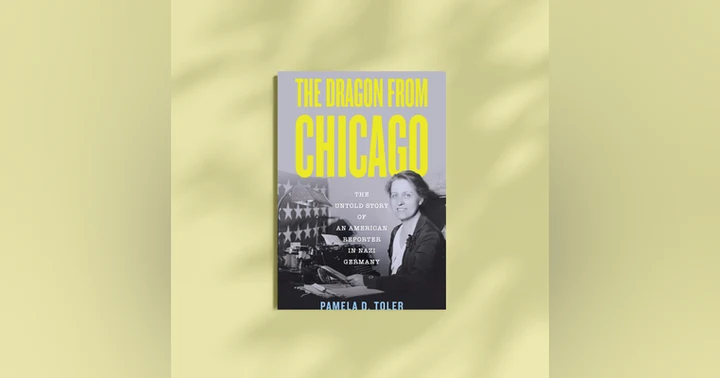
Democracy Undone: The Story of an American Reporter in Nazi Germany | Pamela Toler

What does the rise of authoritarianism look like while it is happening in real time? Historian Pamela Toler, author of The Dragon from Chicago: The Untold Story of an American Reporter in Nazi Germany, joins The Clio Dialogues to tell the remarkable story of Sigrid Schultz, the Chicago Tribune’s Berlin bureau chief who reported on the fall of the Weimar Republic and the rise of Adolf Hitler and Nazi Germany. Toler and host Jennifer Robin Terry discuss how economic and political in...


Description
What does the rise of authoritarianism look like while it is happening in real time? Historian Pamela Toler, author of The Dragon from Chicago: The Untold Story of an American Reporter in Nazi Germany, joins The Clio Dialogues to tell the remarkable story of Sigrid Schultz, the Chicago Tribune’s Berlin bureau chief who reported on the fall of the Weimar Republic and the rise of Adolf Hitler and Nazi Germany.
Toler and host Jennifer Robin Terry discuss how economic and political instability contributed to the collapse of German democracy, what Schultz recognized about Hitler and the Nazi movement before they came to power, and why warnings that appear unmistakable in hindsight can be much harder to recognize in real time. They also explore Schultz’s extraordinary relationship with Hermann Göring.
At its heart, The Dragon from Chicago is the story of a pioneering woman foreign correspondent, as well as that of journalism under authoritarianism, the fragility of democracy, and the importance of a free and engaged press.
In this episode
- Sigrid Schultz and the Chicago Tribune
- the Weimar Republic and the rise of Nazism
- Schultz’s 1931 interview with Adolf Hitler
- the collapse of German democracy
- Hermann Göring and “The Dragon from Chicago”
- the Reichstag fire
- Nazi censorship and surveillance
- freedom of the press under authoritarianism
- foreign correspondents in Nazi Germany
- journalism, democracy, and recognizing authoritarian warning signs
Featured Guest
Pamela D. Toler is the author of ten works of historical non-fiction, for both adults and children, including, most recently, The Dragon From Chicago: The Untold Story of An American Reporter in Nazi Germany. Toler holds a Ph.D. in history from the University of Chicago. You can find out more about her books and her ideas about history, writing, and writing about history at www.pameladtoler.com.
Buy the Book
The Dragon From Chicago: The Untold Story of An American Reporter in Nazi Germany
BONUS: If you order through my Bookshop.org link ~ not only will you get a fascinating book, but you'll also be supporting the author, this podcast, and local independent bookstores. A win for all!
***************
If you enjoyed this episode…
- Hit that Follow button
- Read Clio’s Book Reviews
- Follow on Instagram: @cliodialogues
- Follow on Facebook: The Clio Dialogues
- Follow on Bluesky: @cliodialogues.bsky.social
- Leave a review here or on The Clio Dialogues website
**Reviews and shares make a real difference in helping thoughtful conversations about history reach new audiences.
***************
**History runs on curiosity…and occasionally, caffeine.**
The Clio Dialogues is independently produced. If you'd like to help support future episodes, consider buying me a coffee. Every cup helps keep new conversations coming.
***************
Affiliate Disclosure
Some links in The Clio Dialogues show notes are affiliate links. As a Bookshop.org Affiliate and Amazon Associate, I may earn a small commission on qualifying purchases at no additional cost to you. Those commissions help offset the costs of producing The Clio Dialogues, allowing me to continue bringing historical scholarship to a wider audience. Thank you for your support.
Editorial Independence
The Clio Dialogues supports productive, respectful, freedom of expression.
My opinions are entirely my own, not influenced by affiliates or guests.
My guests’ opinions are entirely their own and may deviate from mine or yours ~ and that’s okay. :-)
Books and products featured on this channel are selected because I believe they are relevant to the conversation and the knowledge is worth having. I will not recommend products I do not believe in.
Jennifer Robin Terry, host
Hello and welcome to the Clio Dialogues, the podcast that links history with the present to help us better understand the world we live in today. I am your host, Jennifer Robin Terry. What are the warning signs of authoritarianism? Would you recognize it if you saw it? My guest today is Dr. Pamela Toler, author of The Dragon from Chicago: The Untold Story of an American reporter in Nazi Germany, which was a finalist for the 2025 Los Angeles Book Prize for Biography. Welcome, Pamela. I am thrilled to talk to you about your book. Thank you for joining me here on the Clio Dialogues.
Pamela D. Toler, guest
I'm delighted to be here.
Jennifer Robin Terry, host
Today we're coming at history from a slightly different angle because your book is a biography. Biographies are really fun because we get to learn about history through the lives of people who actually live through the events. To start us off, can you introduce us to Sigrid Schultz? Who was she?
Pamela D. Toler, guest
Sure. Sigrid Schultz was the Berlin bureau chief for the Chicago Tribune from 1925 to early 1941. She was one of the first American reporters to warn her readers about just how dangerous the Nazis were. She was then of the last to leave Berlin while you could still get out. And I think she's just fabulous.
Jennifer Robin Terry, host
What was she doing in Berlin and how did she get there?
Pamela D. Toler, guest
She was born in Chicago. She spent the first eight years of her life in Chicago, but her father was a portrait painter, and portrait commissions dried up because in 1893 you end up with a major bank panic that turns into the worst depression until the Great Depression in the 30s. So he gets a commission in Germany. He packs the family up, he takes them back to Europe. He and his wife were immigrants. They had immigrated the year before she was born. And he thought he was coming back in two years, but he just got one commission after another. And they ended up staying. It would actually be 40 years before she would live in the United States again, even though she identified herself as an American and an American from Chicago, loudly and often. But she ended up growing up in Europe. She went to local schools in both Germany and France. She spent time in Norway with her Norwegian cousins. So she has a firm colloquial grasp of those three languages in addition to English. And then the Schultz family gets trapped in Berlin during the First World War because both her parents are too ill to leave. She ends up being the family's primary breadwinner during that time. She does a lot of little jobs. And as a result of those lot of little jobs, she ends up knowing people at every level of Berlin society. And then when World War I ends, a lot of American newspapers decided that they wanted to set up foreign news bureaus, which they hadn't really had before the war. And the Chicago Tribune set one up in Berlin. Sigrid ends up meeting the first bureau chief for the Berlin News Bureau, for the Tribune at a big party, a carnival party. She went thinking she was gonna eat wonderful food and dance, and it was a costume ball, and instead she ends up spending the whole night translating because neither of the American reporters that she meets there are able to speak German. The Germans can't really speak English well enough to make themselves understood, but they really want to talk to these American reporters about German economics and politics and to find out what Americans think about Germany after the war. And so she spends the whole night doing this simultaneous translation between German and English and French about politics and history and economics and the new Weimar constitution and Germany's fear that Russia is gonna invade from the East. It literally lasts all night.
Jennifer Robin Terry, host
So she's not a reporter at this point.
Pamela D. Toler, guest
She's not yet a reporter, but this is that's what's gonna make her a reporter is that evening.
Jennifer Robin Terry, host
Did did she want to be a reporter? Was this the goal?
Pamela D. Toler, guest
It had never even occurred to her. She just knew that she wanted to do something, and she was passionately interested in politics from a young age. The gentleman who was the head of the Berlin Bureau for the Chicago Tribune was named Dick Little. He was one of the two reporters at that party. He didn't speak German, which made it really hard to be a reporter. He was totally dependent on translators and on local tipsters, and he was really frustrated with the process. And Sigrid just looked like the answer to a prayer. Soon after that party, he basically handed her a German newspaper and said, translate this editorial for me. And she realized it was a test, and so she worked really hard at getting all the nuance in and stopping to explain what some of the background might be. When that was over, he offered her a job as a translator and cub reporter.
Jennifer Robin Terry, host
That's pretty amazing to have a job like that fall into your lap.
Pamela D. Toler, guest
Yep. And at that point, you know, she's in her early twenties and she basically worked for the Tribune for most of her life as a reporter from that moment on. Wow.
Jennifer Robin Terry, host
Was it unusual for women to do that sort of job in Germany at that time?
Pamela D. Toler, guest
Yes and no. More women were working as reporters and working as reporters overseas than our narrative about women in the workplace would tell us. But she was one of the first, certainly, to become a bureau chief. And she was one of a handful who were working as foreign correspondents. And as far as I can see, they all fell into it.
Jennifer Robin Terry, host
I guess no one is is advertising for a woman reporter at that point.
Pamela D. Toler, guest
No. No. The only exception to that might be back home, because there were newspapers that actively hired women to report on trials as what they called sob sisters, because they believed that women would be more attuned to the emotional nuances of the court than a male reporter might be. So that was one way that women were able to get into hard reporting rather than doing society news or something like that.
Jennifer Robin Terry, host
Interesting. I didn't know that's where the term sob sister came from.
Pamela D. Toler, guest
Yeah.
Jennifer Robin Terry, host
So Sigrid is she does this really through the 1920s. And when does she become a bureau chief?
Pamela D. Toler, guest
She becomes the bureau chief at the end of 1925. So basically her career as bureau chief parallels the rise of the Nazis pretty directly. It's obviously the big story, but she's tracing their rise very clearly every step of the way.
Jennifer Robin Terry, host
And then she interviews Hitler in December of 1931 before he's even really in power. Can you tell us about this interview and what does she think of him?
Pamela D. Toler, guest
She makes it absolutely clear that he is someone to take seriously. I mean, she tells her readers that he told her he did not need to take Germany by violence because he was winning more power with every election, that he was very directly planning to overthrow the German Republic once he was in power, and that he was going to replace it with a dictatorship of what he described as truly Germanic men.
Jennifer Robin Terry, host
So he's really open about this.
Pamela D. Toler, guest
Every step of the way, he's very open in later reports, again before he comes to power. She is reporting what he describes of his plan to drive Jews out of Germany. It's utterly horrifying, but he never pretends to be anything other than what he is. He's very straightforward about what he intends to do.
Jennifer Robin Terry, host
And so she writes this in her article about him. I would think it's like some mega attention or something, but does he get buried or what what happens? Some of them do get buried.
Pamela D. Toler, guest
Her report on the first of the elections, where he begins to gain power in the Reichstag, the parliament, it ends up running on the entertainment page next to an article about Al Jolson and another one about Mae West. It's easy to say this was obviously the big story of the day. It's not necessarily obvious from the United States. And not all of her articles get buried. Lots of them end up appropriately placed. She's on the front page a lot at a time when most women are not writing front page articles. But German politics are not necessarily front page news for the United States until we can't help but pay attention. And I don't think we can be particularly smug about that because today politics in foreign countries are not necessarily front page news on a regular basis. The thing I think is so amazing is that McCormick doesn't cut her off, that he doesn't bury more of the articles because they disagree about everything.
Jennifer Robin Terry, host
And McCormick, he's making the calls at the Chicago Tribune.
Pamela D. Toler, guest
He is the owner and publisher of the Tribune. He's not the editor, but he certainly is directing editorial policy. I mean, he's not pro-Nazi, but he's kind of anti-Europe, and he certainly is an isolationist. And he's anti-Semitic, but in kind of a knee-jerk way, as opposed to a let's do something about it way. But yeah, he just disagrees with her with almost everything, and yet he continues to run her articles. The one that got buried is this very detailed description of the different parties and what they stand for. And it was a long article besides, and I think he basically buried it because it was a too important not to run, but too dull for the average American reader at the time. That's my gut sense of it, though. She is also in that one saying this is a battle between right and left for Germany. She's very clear about how critical that that particular election is. And she was right. That's really the election that sets him on the path.
Jennifer Robin Terry, host
He comes to power when as the Weimar Republic is collapsing. For listeners who are maybe not uh familiar with that history, can you tell us a little bit about that? Take us back to that time?
Pamela D. Toler, guest
Sure. The thing that struck me the most as I started working on this was what a short period of time the Weimar Republic actually existed. It begins at the end of World War I in 1918. It ends with Hitler in power in January of 1933. It's a really, really short time. And Germany doesn't have a democratic tradition. So you don't have institutions in place for the most part. I mean, you've got really strong trade unionism, which is in some ways the democratic base. And they get power thrown to them kind of like, by the way, the emperor is abdicating your turn. The people who became that first set of leaders of Weimar Germany were actually involved in trying to make gradual changes. So having this suddenly thrown in their lap is difficult. From day one, the Weimar Republic is under attack from inside. They are being attacked by the left. The guys who are in charge are democratic socialists. So they're already left of center, but they hold together a centrist coalition. Strong socialist and communist parties on the left are attacking it. Then you've got monarchists and what end up describing themselves as nationalist parties on the right who are also attacking them. And in 1929, you've got crisis after crisis in the Reichstag. They are not able to hold it together. The centrist party is losing control, and they're partially losing control because of the economy. In 1929, when the American economy crashed, it took Germany with it. And that was a boom for both the Communist Party and the Nazis. The Nazis had a membership of 109,000 in 1928, and they had over a million by 1933.
Jennifer Robin Terry, host
Wow.
Pamela D. Toler, guest
And it was because people felt that the government had failed them. Unlike here, where Franklin Roosevelt was pushing money into the economy. In Germany, they were basically saying tighten your belts. So you've got people who are really suffering, and you've got Adolf Hitler who's telling them what they want to hear, saying, This isn't your fault. We're still recovering from World War I. The Jewish international conspiracy did this to us. He doesn't start anti-Semitism in Germany, but he plays on something that's already there.
Jennifer Robin Terry, host
So Sigrid is hovering these stories through the 1930s and as Hitler then takes Germany into war. Her work brings her into contact with Hermann Göring quite often. He's the right-hand man of Hitler, which is amazing. She interacts with him and she does it boldly.
Pamela D. Toler, guest
Yes.
Jennifer Robin Terry, host
He doesn't like her very much. Can you tell us about this relationship between the two of them?
Pamela D. Toler, guest
It's funny, it starts right after they gain so many seats in parliament because Sigrid decides she needs to find a Nazi who's basically whose table manners are good enough that he can come to these Sunday dinners that she and her mother throw that are a big deal. People from all levels of German society come to those. So she sends her assistant out to find someone who's high enough up in the Nazi party that he can give them real information as a newspaper source, but who also, like you said, has good enough table manners to be there. And she actually takes Göring to lunch a couple of times before she decides that he eats an extraordinary amount. At the first time he orders snails and literally eats all the snails the restaurateur has in stock that day. But even though he eats a lot, he eats with good table manners. He's perfectly respectable. It's just he eats a lot. So he becomes her source. And the first party he invites her to, he actually goes out of his way to tell her about the most thrilling moment in his life to date, which was when he was an infantryman and he talks about basically impaling a French soldier on his sword, and he's kind of got her backed against a wall telling her this story that tells her everything she needs to know about the Nazis that they can take this way.
Jennifer Robin Terry, host
That's interesting. I remember a comment, I think she made something about the Nazis confused brutality for masculinity.
Pamela D. Toler, guest
Brutality for masculinity, yeah. Yeah. Yeah. And that very much is kind of sums up her experience with Göring. And also it's, I think, a pretty good description of the Nazis' approach to politics and to the military, by and large. So they end up with this very complicated relationship where he shows up at parties, he and his staff give her information, but at the same time, it just infuriates him that he can't control her. And we end up with, in fact, the incident that the name of the book comes from, because he can't control American reporters the way he controls German reporters. So he starts sending people out trying to entrap one of them as a spy, figuring that it'll take just one big show trial to bring everyone to heal. And one of those attempts is made on Sigrid. A man that her mother doesn't know delivers a box to their apartment and says, Oh, you don't need to worry Sigrid with it. She can see it when she gets home tonight. As soon as he's gone, her mother Hedvick calls the Tribune office and says, Somebody dropped off a package. You might want to come see it. And Segret already has known that there are these attempts going on. So she hurries home, she opens it. Sure enough, it looks like plans for an airplane engine. She knows if she's caught with it in her possession, she'll be arrested, and she suspects that the Gestapo is not far away. So she tears up the pages, she tears up the package, she shoves it all in the fireplace and stays till it's burned down to ash. And as soon as she heads back, sure enough, she runs into a man who she has suspected of being part of these attempts. He's clearly teted to her apartment. He's accompanied by a pair of thugs, and she steps in his path and says, Don't even bother, there's nothing there to find. I destroyed everything. But she decides it's time to call Göring on it. And while she's trying to figure out how to do that, the Foreign Press Club hosts a luncheon with Göring as the guest of honor. It's there to celebrate his second marriage. The press clubs and Göring have a very complicated relationship because they need news and you can't not be polite to the guy who can give you the news. So they've got this party. He's already in a bad mood when he gets there. And because Sigrid is the only woman on the board, she often serves as hostess as these events. She's sitting next to him and she basically just calls him out on this attempt in front of the entire foreign press club. She makes sure she can be heard clearly. One of the things she did in Paris was for a while she studied as an operatic soprano. So when the time came, she could take a deep breath and be heard. He just lost it and basically says, You're never going to learn to show proper respect for authority. It must be because you're from that crime-ridden city of Chicago. And after that, he and his staff called her that dragon from Chicago. And that pretty much summed up their relationship going forward.
Jennifer Robin Terry, host
That dragon from Chicago. But it sounds like he kind of needed her and she certainly needed him.
Pamela D. Toler, guest
Yeah, yeah. I mean, he needed a soapbox. He needed to be able to tell reporters what he wanted them to say. She needed the source, though she certainly had other sources as time went on throughout the Nazi party. So yeah, it's this very complicated dance.
Jennifer Robin Terry, host
And he's a physically imposing man, and she's tiny, isn't she?
Pamela D. Toler, guest
She's quite small. She's barely five foot two.
Jennifer Robin Terry, host
So when he had her backed into the corner and telling her the story about impaling.
Pamela D. Toler, guest
Yeah, he's really looming over her. Yeah.
Jennifer Robin Terry, host
And she still doesn't back down. That's pretty amazing.
Pamela D. Toler, guest
She doesn't back down. You know, later, once the war is actually going on, she has a long correspondence with Colonel McCormick because he likes to hear weekly from his bureau chiefs about stuff that may or may not ever make it to the paper. She tells him, you know, the physical stuff doesn't really scare me. It's actually kind of thrilling. Um so, you know, when she's dealing with bombs going all around her, what gets to her is the being watched, the knowing that she has to watch what she says, realizing that she's self-um censoring when she writes, when she talks.
Jennifer Robin Terry, host
So February of 1933, the Nazis start to crack down on the freedoms freedom of speech, freedom of the press, freedom of assembly. Right. Uh can you tell our listeners a little bit about that? What what spurs that and how do they go about doing that? How does that affect Sigrid's work?
Pamela D. Toler, guest
Well, the first thing is they start cracking down as soon as the Reichstag fire occurs. And they immediately say, before anyone's even had a chance to check, oh, it was a communist, we've caught him. And the reporters are all sure that in fact the Nazis set the fire themselves. But they don't have any proof. And if there's one thing Siegrid believes, is if you don't have a verifiable source, you don't have a story. So even though she tells McCormick that everyone is quite sure that the Nazis set it themselves, nobody was publishing that. But they use that as the excuse to begin to crack down. And they basically, over the course of just a few months, unwind all of the rights that people enjoyed under the Weimar Republic. They take over the German press, essentially. They force Jewish owners of media to sell it to non-Jewish owners, they set up lists of who is properly Aryan, who can work in a newspaper. They dismantle this really thriving press that was there before the war. So that within about a year, Siegret just says, you know, there is no press in Germany. They're just civil servants. They manage to shut down the trade unions and force people to join a giant Nazi trade union that has no power. And the trade union movement was enormously important in Germany during the First World War and also in the Weimar Republic. They shut down, in one way or another, every other existing political party. So we're doing that over the course of the first two months. And, you know, it affects foreigners who are in Berlin. They start realizing that they're being watched, their phones are being tapped, their mails being read. But what really affects Siegret's work and that of every other foreign reporter in Berlin is that the sort of implicit threat that they'd always face, that if you report something your host government doesn't like, you can get in trouble. Certainly people got thrown out of other countries, they got arrested in a couple of cases, they were beaten. And even Sigrid got threatened with being tossed out a couple of times during Weimar. That implicit threat becomes explicit with the new laws. So that if someone publishes news that the Reich doesn't think is in its best interest, now that is treason. And if a reporter if they basically present Germany in a light that the Reich doesn't agree with, which is a fine distinction between the two, but there is at least the explicit threat that they can be thrown out of the country for that. And that gets used with varying degrees because they quickly learn that if you throw someone out of the country, you no longer have any control over what they'll say, and that some of them become media stars as a result. But that threat's always there.
Jennifer Robin Terry, host
So how does she skirt that line? I mean, she's a woman of integrity. She's not going to just report the soft news and be happy with that. What does she do?
Pamela D. Toler, guest
Part of it is she just walks a really fine line all the time because she doesn't want to be thrown out, because she wants to be there. To tell the story, and she knows it's just a matter of time until it's a really big story, and she wants to be there for the show. So she finds a lot of ways of getting around it. One thing she does is she'll put hot news in the middle of a relatively innocuous story. So she'll start with a fluffy piece, or at least a not distressing, dangerous piece, and she'll put the dangerous stuff in the middle, and then she'll circle back to a less troublesome piece of news. And you know, that really works because let's face it, not everyone reads the whole newspaper article. Many, many people read only the first couple of paragraphs. And at that point, the Nazis aren't actually censoring news ahead of time. You only get called in if someone finds it after the fact. And that's not only officials in Germany who are reading, but also Germans in the United States who are reading or people of German descent who are reading. Anyone who reports it to the embassy in DC, then that will get sent back. So there's always this delay. And that works for her because it's often hard to get too upset about something that's two or three weeks old, regardless of what it is. She starts going outside the country to file her reports so that she'll send it from Prague or from Amsterdam and then come back. And at one point she actually sets up a pseudonym so that she can do the really hot stuff without immediate fear of retribution. And she gets interested in that right after the end of the Berlin Olympics of 1936. So it's September 1936. The Tribune Office in Chicago sends a letter to Paris because Paris is safer, telling Siegrid to write an in-depth article about the Knight of the Long Knives, which had happened two years earlier, and it was a really horrific event. It was a slaughter. The Nazis killed the leadership of the stormtroopers. They killed anyone that Hitler thought might be a uh danger to him politically, but they also killed a lot of people who just ended up in the way. You know, people who were married to someone or who had the same name as someone. So it's really a slaughter, and no one really knows how many people got murdered during that. So it would be a big story. Paris didn't handle it very well. They called her at the office to tell her about it, and then the boss at the Paris office sent her the letter to her apartments. It was slid open and ever sincer stamps all over it. So writing it in Berlin would be dangerous. But she did really want to write it because it was right after the Berlin Olympics, and Americans had come, and a lot of them had been taken in by the way the Nazis had cleaned up their act for visiting tourists. And they were coming home and saying, These reporters are just crazy. It was actually very nice there. It was clean, it was well organized, people were polite, people were friendly, the Nazis just aren't that bad. And so she really wanted to write this article that said, yes, the Nazis really are that bad. She took advantage of the fact that she knew the Nazis were watching her, and she told the people in Chicago that she wasn't going to write the article. There was no new information. She'd said everything she had to say in the 12 articles she'd written two years before. Then she went to Paris, she wrote the article there, she sent it to Chicago from Paris and suggested that they run it over a different byline. And the name she suggested was John Dixon. And she later in life pointed out that it was actual tribute to Dick Little, who had been the gentleman who had given her her first job at the Tribune. She had always seen him as her father in journalism, making her Dick's son. And she used that that pseudonym on really hard-hitting investigative reporting until she left, really through the end of 1940.
Jennifer Robin Terry, host
I just love that story. Both because she was able to get her stories out there and no one could figure out who this guy was, and also because of the tribute. I think that's really lovely when we remember the people who help us get to where we get to.
Pamela D. Toler, guest
Absolutely. And and you know, she and the tribune both went to a lot of effort to make sure no one thought it was her. So, you know, she would say things like, gee, I wonder where that guy Dixon got his information. And you know, the the tribune would make comments about, you know, John Dixon going into Berlin for da-da-da-da-da-da. They only acknowledged it at the end of the war when they did give her credit for those articles. It's funny because if you look, because she also would sign letters from John Dixon. And if you look at her signature as Sigrid Schultz and her signature is John Dixon, even though they're obviously very different words, the pattern of the signature is so similar. I mean, if anyone had looked at them side by side, they'd have said, wait a minute.
Jennifer Robin Terry, host
It's a great story. It's wonderful to read about this woman who did amazing things. But I really got this message that democracy is fragile.
Pamela D. Toler, guest
I think it was an unavoidable message given what I was writing about. People come away with one thing. It is this sense that democracy is fragile and that we have to defend it at every step. And the one way you do that is an engaged media. People who are not afraid to stand up and tell the truth. And she did that.
Jennifer Robin Terry, host
To learn more about this and any book featured on the Clio Dialogues, read Clio's book reviews at www.cliodialogues.com. This has been the Clio Dialogues. Please like, follow, and subscribe. And join me again next time because history isn't finished with us.