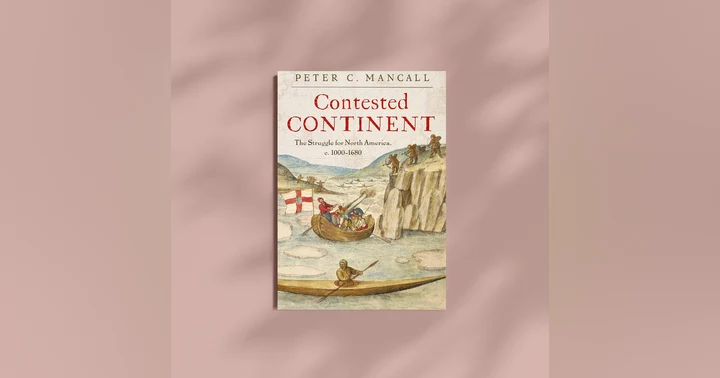
Never Say Inevitable: Rethinking the Road to 1776 | Peter C. Mancall

History only looks inevitable because we already know the ending. As the United States celebrates its 250th anniversary, it is easy to look backward and see a straight road to 1776. In Contested Continent, historian Peter C. Mancall shows just how uncertain that road actually was. He joins Jennifer Robin Terry to explore a North America shaped by competing peoples, incompatible ambitions, and consequential choices. The result is a different, more comprehensive origin story, one that recovers ...


History only looks inevitable because we already know the ending.
As the United States celebrates its 250th anniversary, it is easy to look backward and see a straight road to 1776. In Contested Continent, historian Peter C. Mancall shows just how uncertain that road actually was. He joins Jennifer Robin Terry to explore a North America shaped by competing peoples, incompatible ambitions, and consequential choices. The result is a different, more comprehensive origin story, one that recovers the possibilities obscured when we read the past backward.
In This Episode
- How hindsight can distort our understanding of history
- Why the origins of the United States cannot be reduced to the history of the thirteen British colonies
- How traditional U.S. history surveys race through centuries of Indigenous and colonial history to reach 1776
- Why Europeans were only part of an enormous ensemble cast shaping North America
- How Indigenous peoples determined whether many European expeditions and settlements survived or failed
- Why Jamestown's survival was itself an unlikely historical outcome
- How colonial self-government and enslavement developed alongside one another in Virginia
- Opechancanough’s backstory
- How the 1622 Powhatan uprising and English retaliation marked an escalation in colonial violence
- Why 1619 matters, but does not by itself explain the development of racial slavery in English America
- How economic and political decisions transformed English attitudes toward slavery over the seventeenth century
- King Philip's War, Bacon's Rebellion, and the Pueblo Revolt as reminders of how precarious colonial power remained
- The origins of an extractive approach to the natural world
- Indigenous resistance and a broader history of religious freedom
- Why contingency, agency, and individual choices matter to understanding history
About the Guest
Peter C. Mancall is Distinguished Professor; Andrew W. Mellon Professor of the Humanities; Professor of History, Anthropology, and Economics at the University of Southern California; and the Linda and Harlan Martens Director of the USC-Huntington Early Modern Studies Institute. His scholarship focuses on early America and the peoples, environments, and encounters that shaped North America before the creation of the United States.
Buy the Book:
Contested Continent: The Struggle for North America, c. 1000–1680
Also mentioned:
Edmund Morgan, American Slavery, American Freedom
Alfred W. Crosby, Jr., The Columbian Exchange: Biological and Cultural Consequences of 1492
James Horn, A Brave and Cunning Prince: The Great Chief Opechancanough and the War for America
If you enjoyed this episode…
Subscribe on YouTube
Follow on Instagram , Facebook , or Bluesky
Watch, Listen, Review, and stay up to date: www.cliodialogues.com
Reviews and shares make a real difference in helping thoughtful conversations about history reach new audiences.
**History runs on curiosity…and occasionally, caffeine.**
The Clio Dialogues is independently produced. If you'd like to help support future episodes, consider buying me a coffee. Every cup helps keep new conversations coming.
***************
Affiliate Disclosure
Some links in The Clio Dialogues show notes are affiliate links. As a Bookshop.org Affiliate and Amazon Associate, I may earn a small commission on qualifying purchases at no additional cost to you. Those commissions help offset the costs of producing The Clio Dialogues, allowing me to continue bringing historical scholarship to a wider audience. Thank you for your support.
BONUS: If you order through my Bookshop.org link ~ not only will you get fascinating books, but you'll also be supporting the author, this podcast, and local independent bookstores. A win for all!
Editorial Independence
The Clio Dialogues supports productive, respectful, freedom of expression.
My opinions are entirely my own and are never influenced by affiliate or guest relationships.
My guests’ opinions are entirely their own and may deviate from mine or yours, and that’s okay.
Books and products featured on this channel are selected because I believe they are relevant to the conversation and the knowledge is worth having. I will not recommend products I do not believe in.
Jennifer Robin Terry
Hello and welcome to the Clio Dialogues, the podcast that links history with the present to help us better understand the world we live in today. I am your host, Jennifer Robin Terry.
Jennifer Robin Terry
What if your history class didn't tell you the entire story? Like how, before America was a nation, it was anyone's game. My guest today is Peter C. Mancall, distinguished professor at the University of Southern California, where he is the Andrew W. Mellon Professor of the Humanities and the Linda and Harlan Martins Director of the U.S.C. Huntington Early Modern Studies Institute. He is the author of Contested Continent: The Struggle for North America 1000 to 1680, which is volume one of the Oxford History of the United States, published by Oxford University Press. Welcome, Peter. I am thrilled to talk to you about your book. I am so glad you could join me here on the Clio Dialogues.
Peter Mancall
Well, Jennifer, thank you for having me. I'm really looking forward to our conversation.
Jennifer Robin Terry
We're having this conversation as the United States marks the 250th year since the Declaration of Independence. There's a lot of talk about it, looking backward at American history, and it seems like the march towards nationhood was inevitable the way a lot of history is told. I'm wondering if you could just speak a little bit about how knowing the end or the so-called end can really skew Americans' understanding of the history of North America.
Peter Mancall
That is such a great question, especially to start our conversation. I think that so many books about early America, the period that is before, say, 1800, take as their logical endpoint the revolution and really their logical, logical endpoint, the Constitution. And so this year, the 250th of 1776, there's been a lot of discussion about the Declaration of Independence. And unless I miss my mark, in 11 years, there's gonna be a lot of discussion about how we got to the Constitution. And so when I talk to a lot of people, you know, in this country and other places, they talk about 1776 as the obvious beginning of the nation, and don't really think like we had to have gotten there, or they had to have gotten to that point, right? It was inevitable, it was inexorable. And there are certain grand narratives which point in that direction. My point is in fact that 1776 is a very distant endpoint from the people who I write about in Contested Continent. I end my book almost a hundred years before 1776. And I end my book really talking about what a divided place North America was. Part of what we do when we collapse the pre-1776 period into the inexorable march towards independence, is we'd miss not only the drama of things, but we miss the many ways it could have gone in different directions. We miss the many peoples who contributed to the American experience who sort of got shunted to the side after independence or because of independence or however you want to interpret that. So if my book works as a work of narrative history, if you've followed me from the year 1000 to the year 1680, if you get to the end, you're shaking your head thinking, wait, how do we get to a revolution? Like this guy has not set that up at all. Well, on some deep level, I do set up what happens and what would eventually become the United States. But I don't in any way set up what's going to happen over that almost 100 years from the Pueblo revolt to Philadelphia in 76.
Jennifer Robin Terry
That's an excellent point. And I do want to tell our listeners, this is a hefty book. This is nearly 700 pages of text. And then there's the bibliography and notes and all that goes with it. But it is so good. It reads so well. And for those who may not be inclined to pick up a book and read 700 or so pages, this book is going to be issued as an audiobook in, is it October?
Peter Mancall
It's coming out in October. It's my understanding.
Jennifer Robin Terry
Wonderful. So I think some people will really enjoy listening to this as well as an audiobook.
Jennifer Robin Terry
I'm curious, how much do you think the way US history is taught in school and specifically in college courses, the traditional survey courses, how much does that kind of skew our perspective on pre-revolutionary history? It's a lot of time to cover in 10 to 15 weeks.
Peter Mancall
Yes, I think that's true. And I I think a one-semester survey of the United States, the period that I work on is probably like two lectures, right? I mean, it's sort of dispatched really way too quickly. There's the sort of standard, here's what America looked like, and this is how Native peoples lived. Here are European explorers, here's the European Reformation, here's the slave trade. Boom, we're off to the revolution. I spend a lot of my time talking to K-12 teachers. There's this wonderful Gilder Lemon Institute in New York, which brings faculty together with K-12 teachers. Their textbooks really have almost nothing about the early colonial period in it at all, because the school district's decision is they have to get to the revolution as quickly as possible. If you look at a lot of textbooks for the majority of American history being written, it's really about the modern period. It's really about the post-1900 period. The Civil War is always going to get a lot of attention. It's the great national crisis. The revolution is always going to be there because it gives us both these heroes that everyone's supposed to know about, they're on our currency and things like that, and it gives us the foundations of a government. So those things have to be there. The rest, in whoever puts together these things, doesn't seem that important. Once upon a time, students would learn a lot about what used to be called the age of discovery or the age of exploration. And then that really sort of fell out of favor. It fell out of favor for a lot of really good reasons. But in falling out of favor, it also kind of disappeared. We don't want those heroic narratives about what a great guy Columbus was or Magellan was. You know, we pushed that aside. We also pushed to the side everyone who was there at the time, including the people who are interacting with those explorers, and who really decide which colonies are going to survive and which colonies are going to fail, especially in North America. And so when our trends push us towards the modern period, we lose a lot of the sort of day-to-day, the reality that I think we really need. I think all of us need when we write and read about history. We need the real people behind it, not just the results of what came from their struggles.
Jennifer Robin Terry
I think that's such an excellent point. That's one of the things I find so fascinating about your book, is it is like a really good backstory that is challenging what has now become a familiar narrative. And it is saying, look, this is not a story where Europeans are the protagonists. This is actually an ensemble cast with a whole bunch of people that you have not heard of or thought of in relation to the history of the North American continent. This is a history of struggle, it's a history of failure, of big ideas, and of decisions, but of a whole lot more people than we're typically used to hearing from. And so I wonder when you think about all these decisions and the things that had to happen and the interactions between people, are there some pivotal decisions that really stand out to you that changed the course of history?
Peter Mancall
That's a fascinating question. A really great question. There are a number of times when I try to really understand certain decisions that people made. One of the most unlikely decisions was the English decision to invest in Jamestown. The English had failed constantly in trying to create colonies in the Americas, including in South America, not just in North America. They tried and they had various reasons, and they were in competition with these Iberians, and they wanted to get there, and they saw a lot of their domestic problems being solved by creating colonies, and it made all sorts of logical sense, and yet they keep failing and failing and failing, most famously at Roanoke, but there are other colonies, other places that disappeared also. But here's the thing Jamestown is a complete disaster for the English. Because of strategic reasons, they decide to put Jamestown sort of beyond a little crook in what is now the James River, a place that was just an ecological disaster zone. Like we would call it a super fund site on some level, right? Because the water levels in the James in those days sank really low, and yet they continued to get their drinking water running. They kept doing that for years. And every now and then they decide, okay, we got to get out of Jamestown and expand our territory. Some new governor would come in and say, nope, let's go back to Jamestown again. So what's amazing to me in terms of these fateful decisions, because this leads to two monumental developments. What's amazing to me is that they didn't give up and go someplace else. But here's why this is consequential. This is the place where we see the development of enslavement in the mainland colonies. And this is the place where the English, in their political system, pioneer colonial self-government. These two things are foundational to the American experience. And those developments about enslavement and self-government both happened 12 years after the English get to Jamestown. A lot has happened in those 12 years, and none of it is very good for the English. One other thing that emerges from that decision to stay. What the English saw in front of them was how to govern this particular place. But the person doing that governing was Wahunsunacock, the man who the English Powhatan, and who's most famous because he's Pocahontas' father, and so he has a role in the Disney movie. Everybody knows him because of that. He was the most powerful politician in this place and in this time. And in fact, when he dies is what leads to a really catastrophic war between colonists and the palatins. The English are understanding that it is possible to organize this place, to organize resources, to organize people to do things. And they're also realizing how important it is for them, the people who newly arrived, how important it is for them to get along with native peoples. Not in general, they talked about that in theory, but specific people to form alliances, to go back to one of your earlier questions about how textbooks think about things. One of the things that we do is we presume that Europeans are going to succeed in the Americas. So we presume the Europeans, in this case the English, are going to triumph over these local conditions in Jamestown. And we don't just presume that, we have a very sophisticated modern model, which environmental historian Alfred Crosby came up with called the Columbian Exchange, which emphasizes Europeans extracting resources, which is what they're doing in early Jamestown, and Europeans unwittingly transporting infectious diseases to the Western hemisphere. And so we have a model which almost de-emphasizes the importance of individual relations. And in my book, what I'm trying to say is, yes, infectious diseases really mattered. They were devastating, and I describe some of them in the book in really kind of graphic terms. But they weren't everywhere, and they weren't all the time. What we need to do as historians is to try to give this early past more complexity. That's not just about the Columbian Exchange. It's the Columbian Exchange, very useful device for us. More useful than, say, the concept of manifest destiny, the 19th century concept. It's maybe more useful to us than what Columbus and his followers thought, which is this is all God's plan, not a national plan, but a God's plan. Yes, the Columbian Exchange is a modern thing. But in pushing for those abstract forces, we risk falling into the trap of inevitability. And that strikes me as a very dangerous if we really want to understand any period of history. We have to battle the sense of inevitability in order to show why things mattered and why things developed the way that they did.
Jennifer Robin Terry
Right. I think one of the ways that we do that is by acknowledging a certain sense of agency. And you do that really well by pointing out that indigenous Americans were not just victims. They were not just recipients of the things that Europeans brought, but they were agents in their own right. You have really de-centered Europeans as the main protagonists. So can you tell us a little more about the indigenous Americans and uh their role in this?
Peter Mancall
I really appreciate what you said that I decentered Europeans as the stars of the story. They are in the story. I want them on the stage, but they're not the only people on the stage. And in the entire time period that I write about, ending in 1680, there are more Native peoples in North America than there are Europeans or Africans. The demographic transition, which would eventually come much later, a hundred years or so later, and that's in eastern North America. You have to go into the 19th century to really have a demographic transition where native peoples become a statistical minority compared to the descendants of Europeans. So by decentering Europeans, I'm really trying to say, let's look who actually is walking on this historical state. In the early period, they're overwhelmingly native, and even late into the period, they're still mostly Native peoples. One of the crucial things to understand is that Europeans have certain ideas about what various parts of the Americas are going to be like based on other Europeans' views. And some of those ideas are native peoples are simple, we can take advantage of them, we can kidnap them because they're not very militarily superior. Native peoples live in this bounteous environment which has everything we could possibly want, and we're going to extract all this wealth, and that really accelerates once Spaniards get to Mexico. These ideas get set in Europeans and start reading other Europeans, missing the point that most knowledge about North America is indigenous knowledge about North America. And oftentimes when Europeans try to go someplace and they don't succeed, they blame it on sort of inadequacies. This is really true in the North, in the Arctic. They say this place is uninhabitable. We can't go there, missing the fact that it is inhabited, that people that people are living there, and that those people are determining if the visitors are going to live or die by taking care of them or ignoring them or attacking them. So I think a reader of my book will assume at the point of contact, native peoples have a lot to say. When you get to the latter chapters, I have two chapters near the end, which I make the point that sort of answered the spirit of your question. One is a chapter that looks at the Mississippi Valley at the end of my time period, that is the 1660s, 1670s. And it's basically making the point this place has not radically changed. This is Indian country. It's still Indian country. Yes, there are Europeans traveling through, and the Europeans know that they are completely at the mercy of whatever native group they are near. But part of why I have that chapter near the end of my book is to say that almost 200 years after Columbus, most of North America is unchanged by the arrival of Europeans. Then the last major chapter of my book, I talk about a series of very bloody encounters. Bacon's Rebellion is famous for pitting colonists against colonists. It's the subject, among other things, of one of the great books of early American history, which is Edmund Morgan's American Slavery and American Freedom, in which Bacon's rebellion plays a crucial role in why white Virginians turn towards enslavement much more eagerly after 1676. The other two conflicts, though, Medicoms, which is across southern New England into Coastal Maine, and the other one, the Pueblo Revolt, which is in New Mexico, these are conflicts of native peoples against colonizers, and these are native peoples who were saying enough. In New England, what that would mean is territorial expansion. In New Mexico, what that tended to mean is the demands that both troops and priests were putting on indigenous peoples reached a point that it was too much. And in both those cases, there are these very powerful indigenous rebellions. These were catastrophic to Europeans, and one could imagine a scenario that had Europeans already not been established in these areas, especially in New England, they might have said, no, this is not our time to colonize. The Spanish actually do leave New Mexico. They're out of New Mexico for 12 years. I mean it's the most successful native revolt in American history. It's also a revolt which is uncomfortable to many modern Americans, because it's fairly clear from the documents that it's not just a revolt against people trying to take our land or even enslave us. It is a revolt against the religion of the Europeans, which in that case is the Catholic Church, and the systematic assaults on the church, which come through in testimony from colonial and native observers, really are shocking to modern readers. I emphasize them to say not everything boils down to a competition for what would be the word worldly resources, that some people are very, very upset at the presumption that your faith is greater than my faith, that you can make me believe something that I'm not inclined to believe, and that the way you're forcing me to do that I find unacceptable. It really tells us something more, or maybe different, than our typical way of looking at rebellions, which is you're taxing us too much. This is we are trying to eradicate something which isn't visible. Tells us a lot about interaction. I think it tells us a lot in our Spain, Europeans and Native peoples over the course of that colonial period.
Jennifer Robin Terry
Yeah, I agree. Don Luis, Opecancanough, was an indigenous man who ends up interacting with the guys in Jamestown. Tell me the story.
Peter Mancall
The story is somewhat involved, but I'll give you the short version of the story.
Jennifer Robin Terry
Okay.
Peter Mancall
Um Spanish explorers, Spanish colonizers either adopted or kidnapped this young, young guy who spends some time in Cuba, goes to Spain, and comes back. And as far as the Spanish are concerned, he is converted. He is like one of them, and he can be very useful in their in their plans. And one of the plans that some Spanish missionaries come up with is we're going to plant a mission near Chesapeake Bay. So they take this young guy along. The Spanish are now calling him Don Luis. There's a wonderful biography of him by a grave server named James Horn. Now he's not from this region originally, as far as we know. He's from somewhere else. And so he goes with a small number of missionaries setting up a small establishment. For people who know their film history, I sort of say if you remember the movie Black Robe, there were very good visualizations in Black Robe about what these early mission camps were like. Well, something happens, and this young man, Don Luis, allies himself with local people, and they rise up and they kill the missionaries. This young guy, and he's still relatively young-ish, he's maybe in his twenties, maybe he's 30. He disappears from the record because there aren't Europeans out there keeping records. He then re-emerges as an ally of Wahun Seneca, of Palatin, now known as Opichen Kanoo. This guy now, as an adult in the 16 teams, becomes sort of a war captain for Wahunsenacock, for the Palatins who are meeting the English. After Wahun Seneca's death and Pocahontas' death, which are almost at the same time, he emerges as this powerful military figure, and then he leads a rebellion in 1622, which the English refer to as a barbarous massacre. And then he would survive that, and he would live into what is becomes the third Anglo-Palatin War in the 1640s, where he is captured and shot. Now, why this guy who's not from the area did that, the missionaries never recorded, and to my knowledge, there's no recorded oral history that survives to explain why what happened in 1571 happened. But he becomes a hugely consequential figure. He plays a starring role in what becomes a turning point in English colonial history. After Opichenkano leads that rebellion in 1622, the English are just enraged by this. So the English launched this huge assault. In the spring of 1623, in an effort to kill Opichenkano and his followers, a group of English soldiers sail up the York, sail them to Pamunkey territory, which is where Opichenkano was living, and they distribute a poison to 200 people. But this kind of stuck with me. I'm thinking, wait, I don't think I've ever seen that before. So I then start digging back into the English conquest of Ireland, which I thought would give me some examples. I go back to other times when the English are doing violent things to other people. There are no instances of mass poison. At the moment that this happens in 1623 is just when the English are codifying their understanding of the laws of war and peace. And they go out of their way to say you can't use poison in war. And so now let's go back to the Chesapeake in 1623. What is going on here? Why do they decide to do it? The people that do it first claim they didn't do it. Then they sort of back up and they more or less admit that they did, but they also knew it was wrong. Poison is not a casual act. To poison 200 people means you need to prepare a lot of poison. They are doing something that they know is wrong. Though there's violence before this, including in this area in what's called the First Anglo-Palatin War, which what's from 169 to 1640? It's hard to put these things in a relative scale. The violence that comes after this is much more devastating and dramatic and much more organized, not just attacking colonists, colonists attacking native communities. And then that would reach a culmination in part in the most infamous incident in early New England history, which is during the Anglo-Pequot War, the burning of a Pequot village on the banks of the Mystic River. I don't really imagine that happening 50 years earlier. And so part of what I tried to do in Contested Continent is say what's going on, which is changing how people see each other.
Jennifer Robin Terry
You can definitely see there's this turning point where the violence, it's not self-defense, it's not misunderstanding. It is actually premeditated and calculated and on a larger scale of wiping out people rather than defending against. A perceived threat.
Peter Mancall
Exactly. That's exactly right. And these things are happening at the same time. The English are expanding the number of enslaved Africans they're bringing. So a different form of violence and destruction of communities is happening at the same time.
Jennifer Robin Terry
One of the points of your book is that institutions are not inevitable. And we need to understand that institutions are a result of concerted decisions and actions. What struck me was when I was reading about the Spanish, and the Spanish are having a hard time forcing indigenous people to work, so let's turn to Africa and import people. But the English seemed to think that wasn't the way they were going to go about things until maybe 1619. And then they decided this is the way that we are going to proceed. It was a concerted decision. Can you tell us about that?
Peter Mancall
When the English are first thinking about colonizing North America, they're doing it after the Reformation has already happened, right? And so they are basically saying we are going to change this place and make it not just part of Europe, but part of Protestant Europe. And it's going to make sure we're not like the Spanish or the Portuguese. We're not going to be like these people who, among other things, enslaved indigenous and participated in the slave trade. We're going to be different. And in fact, when Elizabeth is the queen, they make an explicit point that we don't need to ever enslave people. We wouldn't do that. Iberians would do that, not us. And in fact, one of the reasons for going to North America is to get rid of all this, as the English promoters would think of it, surplus people, people who can't find work, especially young men, they may be dangerous at home. Let's get rid of them. We'll never need enslaved people because we're going to solve our domestic problem, overpopulation, as they thought of it, by providing a labor source to extract resources, which is what they wanted. So at the very beginning, there's even a proclamation from Elizabeth herself, the English are not intending to enslave people. They, in fact, criticized the Spanish for having done so. In those early years of the 17th century, Elizabeth is now gone. In an effort to establish a viable extraction economy in Bermuda, the English acquire some enslaved Africans. In 1619, the English capture a ship and the first enslaved Africans come to the mainland English colonies. The 1619 project and the big debate about the 1619 project really made it sound like that is the great turning point in American history. That that was it. Well, it was important, but it's very important for us to understand that the laws are not entirely clear about the legal status of these individuals. They are presumptively enslaved in the colonies. They're certainly treated like they're enslaved in the colonies, but the laws are ambiguous, and the laws remain ambiguous through the middle decades of the seventeenth century. The majority of laborers going to the Chesapeake in the middle decades of the 17th century are English. Sometimes they're Irish, but basically they're organized by the English. The English, in their official rhetoric, really don't want to embrace the idea of enslaved Africans in their American colonies. By the middle of the century, things begin to change, in part because of the great expansion of the tobacco economy and the expansion in the islands, especially of the sugar economy, which is really where the English got involved most heavily in the transatlantic slave trade. But in the mainland, there is growing demand for labor. And though the English still seemingly prefer other English to do their labor, that's to be indentured servants, other developments change the calculus. And the most important in that are these two disasters that hit England in the middle of the 1660s plague and the Great Fire of London. Those two things together all of a sudden create enormous job opportunities for anyone who's unemployed or underemployed in England. No need to cross the ocean, no need to sign up your labor for five years. By the way, we heard it's terrible over there. They're going to stay home. At the same time, the sugar economy is booming and the tobacco economy is booming, and there's constant need for labor. And eventually, by the early 1670s, this need for labor reaches the highest levels of English society. And we see the creation of the Royal African Company, in which the royal family decide, okay, we're going to get involved in this business. That is a radical shift from what Queen Elizabeth had in mind three generations earlier. So the English within a relatively short amount of time really make a substantial conversion and embrace. So 1619 is absolutely important as a date. But what I hope I do in contested content is say, yes, but let's see how these things emerge kind of in as much as possible real time from 1619 through the 1670s. I think that Professor Morgan was right in American slavery, American Freedom. I do think it's the debate that happens as a result of Bacon's rebellion. We see this in the laws, much more eagerly embraced the idea of enslavement and keeping people, not only for their entire lives, but one of the crucial things about slavery as it was in the law in America is the children of enslaved women became the property of the person who claimed ownership of her. That was a very important step towards establishing a form of enslavement that did not exist earlier. Certain foundational things about modern life emerged in this period. One, the idea that nature exists to be harvested, that we human beings can extract whatever we want from the natural world regardless of the consequences. That idea did not exist before this time period. This is the origins of our modern ecological crisis. Yes, the Industrial Revolution mattered, but the origins of our modern ecological crisis were this idea. And this idea really developed in the Americas more than anywhere else in the world in the early modern period. And it developed because of an idea that Europeans could simply extract what they want. That is foundational. Second of these kind of larger takeaway points. The development of enslavement as it happened in this earlier period led to the acceptance of a society of gross inequality. The greatest inequality was between the free and the enslaved. But over time, inequality became foundational to America. A third takeaway. The United States, in the process of creating that nation, it displaced hundreds of indigenous communities. Native peoples didn't disappear. Native peoples are shaping everyday life throughout this entire time period. And finally, it is in the early American period when certain ideas about what we think of as religious freedom did spread across the continent. That meant different things in different places. The American stereotype is pilgrims and puritans, religious dissenters who leave the Church of England and endure these hardships. But that same idea about religious freedom applies to Pope and his followers, who are basically saying to the Catholic Church, our native faith matters. This is what we want. We have the freedom to establish that. Our only way to understand history is to understand the things that individuals struggled with. So I tried to demonstrate agency, the people have it. Tried to stress the importance of contingency, the decisions people make on one day change what happens on the next day. I think it's very important, even when we talk about big picture history on contestant continent is a big picture history to bring it down to the level of the individual and the individual story. There's a famous line by Joan Didding who tells stories to make sense of the world. I'm telling stories which kept it proud of the archives sometimes. And the tellers may be imperfect tellers, but there's still a lot of stories there and they're worth listening to. And I hope I've brought some of the humanity of a whole bunch of people back into our present discussion.
Jennifer Robin Terry
This has been the Clio Dialogues. Please like, follow, and subscribe. And join me again next time because history isn't finished with us.