Clio's Review: Contested Continent
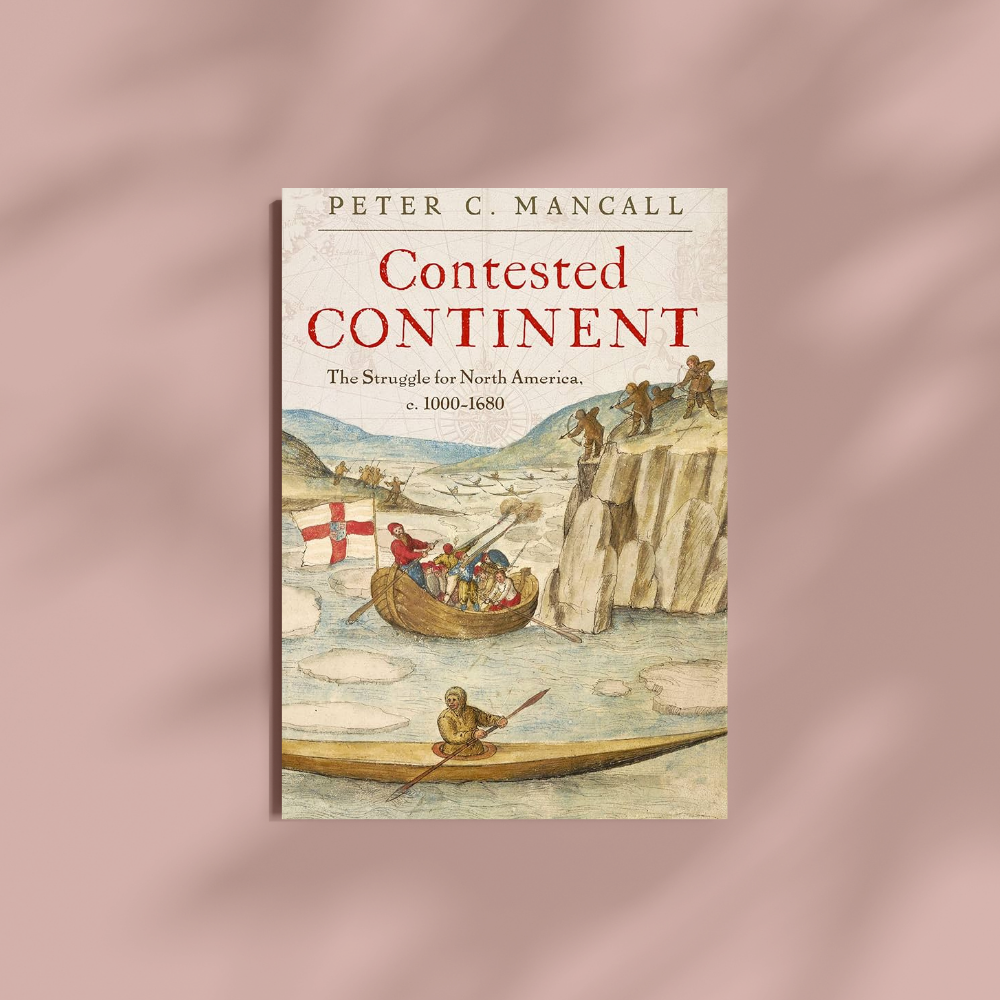
Peter C. Mancall, Contested Continent: The Struggle for North America, c. 1000–1680 (Oxford University Press, 2026).
Peter C. Mancall’s Contested Continent: The Struggle for North America, c. 1000–1680 is an ambitious and deeply impressive work of history. Spanning nearly seven centuries, Mancall reconstructs and relates the history of America as it was long before the United States’s founding fathers (and thus, the nation) were ever born.
Mancall starts around 1000 CE, highlighting the spread of maize agriculture and Indigenous political and economic networks, developments that were essential to the history that unfolded. While one could easily get lost in a big picture story such as this, Mancall’s commitment to elevating individual voices and experiences results in a story with an ensemble cast, one that decenters Europeans as they share the stage with Indigenous peoples and Africans. It is a shared history of migration, trade, environmental change, violence, conquest, and adaptation. This is not the simple or traditional march from Jamestown, to Plymouth, and then on to the American Revolution.
The book’s most important contribution is its sustained emphasis on contingency. European domination appears neither swift nor inevitable. Colonization attempts repeatedly failed, Indigenous peoples remained powerful across much of the continent, and imperial ambitions collided with local circumstances that Europeans often poorly understood. Even in 1680, after nearly two centuries of colonization efforts, North America remained profoundly contested. Rebellions in New England, Virginia, New Mexico, and Barbados exposed the instability of colonial societies and the limits of European power. Mancall argues persuasively that chance, adaptation, and catastrophe mattered as much as imperial design.
Equally important is the book’s continental and Atlantic scope. Mancall integrates Indigenous history, environmental history, slavery, religion, and imperial rivalry rather than allowing any one of them to become a subsidiary story. By the end, “America” has emerged not as the fulfillment of a predetermined national trajectory, but from the unexpected interactions of peoples who could not know where their choices would lead.
I thoroughly enjoyed Contested Continent. It is a significant work of scholarship, expansive without losing sight of human experience, and a compelling reminder that history only looks inevitable when viewed in hindsight.
Watch or listen to my conversation with Peter C. Mancall to learn more about the many possible Americas that might have emerged, then pick up a copy of Contested Continent to explore the full story for yourself.
Clio's Review of The Place in Europe