Clio's Review: I Humbly Beg Your Speedy Answer
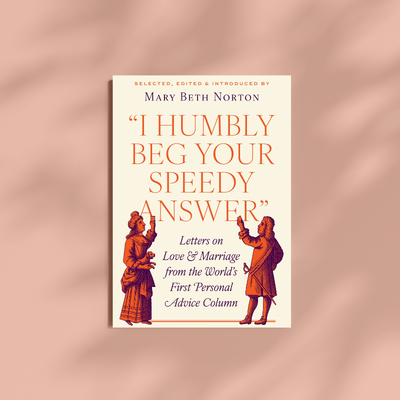
Mary Beth Norton, “I Humbly Beg Your Speedy Answer”: Letters on Love and Marriage from the World's First Personal Advice Column (Princeton University Press, 2025).
Mary Beth Norton’s I Humbly Beg Your Speedy Answer offers a fascinating, deeply human look at letters that were submitted to London’s Athenian Mercury in the 1690s. Established by printer John Dunton as a wide-ranging question-and-answer publication for the male-dominated world of London’s coffeehouses, the Athenian Mercury soon became something its creators had not anticipated: the world’s first personal advice column. In assembling and editing these exchanges, Norton provides an unusual window into both the emotional lives of seventeenth-century people and the social structures that constrained their choices.
What makes Norton’s volume so engaging is how instantly recognizable these centuries-old anxieties feel. Organized thematically around courtship, choosing a spouse, parental consent, promises and vows, marriage, and sexual behavior, the collection reveals correspondents struggling to reconcile affection with economic necessity, familial expectations, religious obligations, and reputation. The Athenian Mercury's editors (Dunton and his two brothers-in-law), grounded in strict Protestant morality and pragmatic class considerations, were at times severe in their advice. Yet, at others, they were surprisingly generous and even-handed, even to women (a notable rarity at that time).
Particularly illuminating are questions surrounding marriage itself. In an era before English law clearly defined marriage, letter-writers often worried whether private promises and mutual agreements constituted legally binding unions. In what may be both amusing and astonishing to modern readers, they frequently asked for clarification as to whether they were married and to whom.
Norton’s modernizing edits smooth out the tangled 17th-century syntax without stripping away the historical flavor, humor, or vulnerability of the original voices. The collection bridges the gap between scholarly analysis and social history, showing that while our technologies change, our messy romantic dilemmas remain strikingly constant.
I Humbly Beg Your Speedy Answer contributes to the histories of gender, marriage, print culture, and everyday life while reminding us that heartbreak, bad judgment, and questionable romantic prospects are hardly modern inventions.
For readers seeking advice as to whether to acquire a copy, I humbly beg you not to wait—my speedy answer is, buy the book!

Clio's Review: The Dragon from Chicago