Clio's Review of Proving Pregnancy
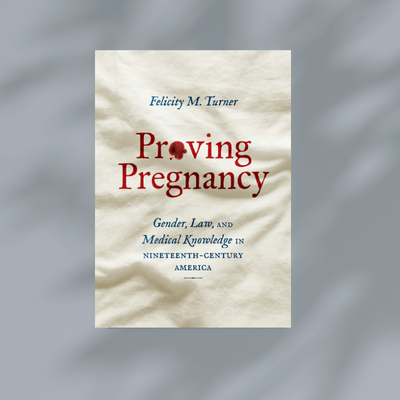
Felicity M. Turner, Proving Pregnancy: Gender, Law, and Medical Knowledge in Nineteenth-Century America. University of North Carolina Press, 2022.
In the early American republic, infanticide could be prosecuted without evidence of a deceased infant. Under laws inherited from seventeenth-century England, an unmarried woman suspected of having given birth could face prosecution for concealing the birth. When such accusations arose, it was other women who examined the accused and testified about the physical evidence of whether she had recently been pregnant. Black or white, midwife or not, women possessed an expertise in pregnancy and childbirth upon which all-male juries depended. Men held legal authority, but women possessed the knowledge necessary to exercise it.
In Proving Pregnancy, historian Felicity M. Turner argues that women's embodied knowledge constituted a form of intangible property, conferring authority, respectability, and standing within their communities. As medicine professionalized, however, credentialed male physicians increasingly claimed that expertise, diminishing women's authority over matters they had once been uniquely qualified to judge.
Organized into six chapters, Turner's study traces these changes from the founding of the United States through Reconstruction. Drawing primarily on inquest records, newspaper accounts, and medical literature from North Carolina and Connecticut, she reconstructs how women's testimony shaped criminal investigations and how changing standards of medical expertise gradually undermined its legitimacy.
Turner extends the historiography of women's property rights beyond tangible possessions while complicating narratives of medical progress. The transition, she writes, was neither inevitable nor simply a deliberate campaign to exclude women. Rather, professionalization redefined legitimate expertise, with consequences shaped by race and class. By the late nineteenth century, physicians increasingly claimed authority over women's minds as well as their bodies, invoking female biology and mental instability to question women's intellectual capacities. Such reasoning also contributed to unequal treatment of women accused of infanticide, with assessments of mental competence and emotional fragility producing sharply different outcomes.
Although focused on the specialized context of infanticide proceedings, Turner's analysis illuminates broader transformations in law, medicine, and women's rights. It offers a valuable perspective for scholars and students of all three fields. Proving Pregnancy challenges readers to reconsider what constitutes property, who determines expertise, and what women lost in the name of medical progress.
Knowledge is power. Why not claim a little more of it? Watch or listen to my conversation with Felicity Turner on The Clio Dialogues, then pick up a copy of Proving Pregnancy.

Clio's Review of The Place in Europe