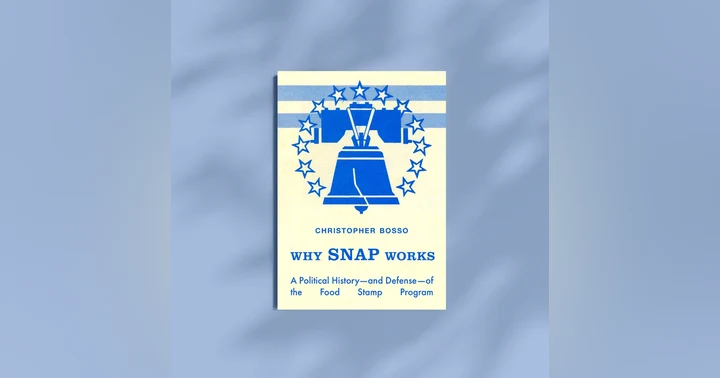
SNAP Under Fire: The History Behind Today’s Food Stamp Debate | Christopher Bosso

𝐄𝐩𝐢𝐬𝐨𝐝𝐞 𝐃𝐞𝐬𝐜𝐫𝐢𝐩𝐭𝐢𝐨𝐧 Why is one of America's most successful anti-hunger programs suddenly at the center of legal and political controversy? Recent battles over restrictions on purchases through the Supplemental Nutrition Assistance Program (SNAP), the nation's largest government food assistance program, have reignited debates over nutrition, personal choice, and the proper role of government. But as Christopher Bosso explains, those debates are far older than they appear. Bosso takes listener...


𝐄𝐩𝐢𝐬𝐨𝐝𝐞 𝐃𝐞𝐬𝐜𝐫𝐢𝐩𝐭𝐢𝐨𝐧
Why is one of America's most successful anti-hunger programs suddenly at the center of legal and political controversy?
Recent battles over restrictions on purchases through the Supplemental Nutrition Assistance Program (SNAP), the nation's largest government food assistance program, have reignited debates over nutrition, personal choice, and the proper role of government. But as Christopher Bosso explains, those debates are far older than they appear.
Bosso takes listeners back to the Great Depression, when policymakers faced what journalist Walter Lippmann famously called the "paradox of want amidst plenty": farmers were producing more food than Americans could buy, even as millions struggled with hunger. The solution they ultimately devised would evolve into the Food Stamp Program, and later, SNAP.
Along the way, Bosso explains why early food distribution programs proved unpopular, how food stamps restored dignity and consumer choice, why the program was revived during the War on Poverty, and how an unlikely political alliance between urban and rural lawmakers helped ensure its survival. The conversation also explores recurring debates over who deserves public assistance, why Americans often support food aid even while expressing skepticism about welfare, and why SNAP has remained remarkably resilient through changing political administrations.
Whether you've followed the recent headlines or never given SNAP much thought, this episode reveals how a program created to address the economic challenges of the 1930s continues to shape American life nearly a century later.
𝐈𝐧 𝐭𝐡𝐢𝐬 𝐞𝐩𝐢𝐬𝐨𝐝𝐞:
- Why SNAP has returned to the headlines
- The surprising origins of the Food Stamp Program during the Great Depression
- The "paradox of want amidst plenty"
- Why early government food boxes failed
- How food stamps transformed food assistance through consumer choice
- The role of the New Deal, the War on Poverty, and Richard Nixon in shaping SNAP
- Why debates over nutrition restrictions are nothing new
- How SNAP became one of America's most politically durable social programs
- Why the history of SNAP continues to shape contemporary debates over hunger, poverty, and public policy
𝐆𝐮𝐞𝐬𝐭
Dr. Christopher Bosso is Professor Emeritus of Public Policy and Politics at Northeastern University.
𝐁𝐮𝐲𝐭𝐡𝐞𝐁𝐨𝐨𝐤:
Why SNAP Works: A Political History--and Defense--of the Food Stamp Program Bookshop.org or Amazon
Also mentioned:
Framing the Farm Bill: Interests, Ideology, and the Agricultural Act of 2014 Bookshop.org or Amazon
***************
𝐈𝐟 𝐲𝐨𝐮 𝐞𝐧𝐣𝐨𝐲𝐞𝐝 𝐭𝐡𝐢𝐬 𝐞𝐩𝐢𝐬𝐨𝐝𝐞...
Follow The Clio Dialogues wherever you listen to podcasts, leave a review, and share this episode with someone interested in American history, constitutional law, immigration, or the history behind today's headlines.
**𝐇𝐢𝐬𝐭𝐨𝐫𝐲 𝐫𝐮𝐧𝐬 𝐨𝐧 𝐜𝐮𝐫𝐢𝐨𝐬𝐢𝐭𝐲... 𝐚𝐧𝐝 𝐨𝐜𝐜𝐚𝐬𝐢𝐨𝐧𝐚𝐥𝐥𝐲 𝐜𝐚𝐟𝐟𝐞𝐢𝐧𝐞.**
The Clio Dialogues is independently produced. If you'd like to help support future episodes, consider buying me a coffee. Every cup helps keep new conversations coming.
***************
𝐀𝐟𝐟𝐢𝐥𝐢𝐚𝐭𝐞𝐃𝐢𝐬𝐜𝐥𝐨𝐬𝐮𝐫𝐞
Some links in The Clio Dialogues show notes are affiliate links. As a Bookshop.org Affilate and Amazon Associate, I earn from qualifying purchases. In other words, if you purchase a book or other eligible item through one of these links, I may earn a small commission at no additional cost to you. If you order through my account on Bookshop.org, not only will you get fascinating books, but you'll also be supporting the author, the podcast, and local independent bookstores. A win for all!
Those commissions help offset the costs of producing The Clio Dialogues, allowing me to continue bringing historical scholarship to a wider audience. Thank you for your support.
Speaker
Hello and welcome to the Clio Dialogues. The podcast that connect history with the present to help us better understand the world we live in today. Can a government fight hunger without sacrificing consumer choice? In a nation overflowing with food, that question has shaped public policy for nearly a century. Recently, battles over SNAP have reignited debates over who should receive public assistance and what recipients should be allowed to buy.
Speaker
My guest Dr. Christopher Bosso explains, those debates are far older than they appear. Bosso is Professor Emeritus of Public Policy and Politics at Northeastern University and the author of Why SNAP Works: A Political History and Defense of the Food Stamp Program.
Speaker
Speaker
Speaker
Hello, Christopher. It's so nice to see you, and I appreciate you joining me here on the Clio Dialogues. Well, thank you, Jennifer. It's great to be here. There has been a lot of controversy recently in the news about SNAP and restrictions on what recipients can purchase. So before we get into the history, can you explain a little bit, first of all, what is SNAP and why is it so controversial?
Speaker 1
Well, SNAP is the Supplemental Nutrition Assistance Program, which historically until 2008 was known as Food Stamp Program. We got rid of physical stamps in 2002. So, you know, they updated the name to Supplemental Nutrition Assistance Program to reflect the fact they're no longer stamps. The money is deposited directly into an electronic card. So the name reflects its purpose to supplement the nutritional lives of those who get the benefits. Obviously, some folks still use the old term food stamps, but those who support the program typically use SNAP instead. It's controversial because, well, it's always controversial when we're using public money in support of those who are less well off. I mean, it's always been a controversial dimension in the US American social welfare narrative about who is deserving, who is not deserving of our tax dollars. So SNAP has always been controversial in a sense because you know essentially it's subsidizing people's ability to buy food. And, you know, with that support comes a set of judgments. What are they allowed to buy with those benefits? Are they acting correctly? Are they acting in terms of nutritional value for what they're purchasing? So, for example, the debate right now about what foods you can and cannot buy with SNAP is a controversy that reflects an old lineage going back to the origins of the program in 1964. And you know, now I should say right now, by law, the SNAP program does not have any restrictions on the food you can buy with your benefits. There's an asterisk here. You cannot buy hot prepared foods, for example. Because the idea was you buy the food and you prepare it at home. So, for example, the famous Costco rotisserie chicken that was $4.95, which is a real, you know, a real benefit. Well, you cannot use your Snapdollars to buy that chicken because it's a hot prepared food.
Speaker
I see. So the expectation is that people will purchase uh dry goods, canned goods, or whatever, and prepare it with their own two hands. They gotta work for it.
Speaker 1
Exactly. You could buy that same rotisserie chicken that's cold and maybe even in the freezer and prepare at home. But as long as it's hot and prepared food, you cannot use it. Now, there are always tons of asterisks. There's you know, there's all kinds of carve-outs for elderly, you cannot cook at home necessarily, or there's sometimes carve-outs for disasters. That's the only typical restriction. Um, of course, you cannot buy alcohol and cigarettes. And the reason for that is the USDA historically did not want to get in the business of deciding what was a good food and what was a bad food, because that's politically fraught. The food industry doesn't like that distinction. All food is good food as far as the food industry is concerned. So the current effort by the Trump administration in giving waivers to states to allow them to restrict certain kinds of sugar-sweetened beverages or snacks, these are called pilot programs. And so a recent federal court has ruled that these pilot programs, these waivers, are not based on law. They're actually being granted illegally. There always have been those who wanted to restrict what people getting SNAP benefits could use with their benefits, out of that view, we don't want the poor wasting their dollars, their tax dollars on bad foods. Um, well-intentioned in some cases by nutritionists who would like to see SNAP dollars being used for very good nutritional purposes. But you're going to see how these things intersect at a point where those defending the program really get nervous because once you start going down the path of putting restrictions or determining what people can use their SNAP dollars to buy, you're essentially with the WIC program, Women's Infants and Children's Program, which essentially is a very prescriptive, something overly paternalistic program that really dictates what you can use those benefits for. And so this one of the political sort of strengths of SNAP is that it historically has not made those judgments. It has allowed consumers who are getting who are getting SNAP benefits to act like American consumers to purchase whatever foods they think fits their lives and their families. Choice. So the current debates about sugar-sweetened beverages and you know, and and other kinds of foods intersects with the historic and still legal definition of SNAP as you can use it for whatever foods you wish to purchase. And so the Trump administration, echoing in many respects the Robert Kennedy Jr.'s Maha movement, is put these waivers into place in certain states, almost exclusively the Republican states, and trying to restrict what SNAP users can use with their benefits. And there, and the rationale given is that they want to promote healthier eating. Okay, fair enough. Those who study this the program are doubtful that will have much impact. Because what's a two-liter bottle of coke cost at your at Costco or Walmart? What, $3? You know, it's cheap. And so if you don't use your Snapdollars to purchase that two-liter bottle of Coke, and you still want to let your kids have a glass of coke, you're gonna use your own money to buy it. So there's a substitution effect. You know, economists doubt that these kind of bans will have practical impacts on improving people's health.
Speaker
I imagine there might be some confusion too over what is healthy foods, right? I mean, like candy bars seem like an obvious it's full of sugar, but there's actually a lot of fruit snacks and granola bars and things like that with just as much sugar.
Speaker 1
Exactly. And that's what some of the states have wrestled with. Some of the states have been very narrow in their definitions. You can't use it for sugar sweetened sodas, and you cannot use it for candy. But then you get into granola bars, you're right, or protein bars. Okay, some baked goods are okay, because maybe the bakery lobby in that state has some clout. I don't know. But some states have really wrestled with this. And actually, some states have delayed implementation because it's so complicated. Because the retail industry in that state has to redo their systems to kick out any food that's not approved. And that was one of the reasons why historically they had decided not to go that route, because it was so complicated administratively, even with modern systems.
Speaker
And some people have argued that maybe just giving them more cash is the answer. What do you think of that?
Speaker 1
Well, economists will say the simplest way to elevate people's household incomes and quality of life is to give them more cash. Cash is the most flexible thing we have. But we don't like to give poor people cash. We don't trust them. And why is that? We don't think they make wise choices. In fact, we don't do much direct cash welfare in the United States anymore. In fact, we've, you know, the cash assistance is a relatively small portion of the American welfare state. We do everything by vouchers: Section 8 vouchers for housing, heating vouchers for heat, uh, transportation vouchers. SNAP is essentially a voucher. It's used, it's used for specifically for food.
Speaker
So let's uh let's talk about where this all began. Can you take us back to the Great Depression? This actually started not with an anti-poverty focus, is that correct? No, no, no.
Speaker 1
It's sort of the classic paradox of want amidst plenty, as it was called back then by Walter Littman, the great uh newspaper columnist of that period. And it was something like this. You had during the Great Depression 25% unemployment, breadlines, people desperate for food. At the same time, farmers were in a post-World War I overproduction phase. They were still producing too much food. They had been encouraged to overproduce, but demand is not increasing. In fact, demand is slumping because of trade wars in the post-World War I period. You have the decline of the European market as they improve their own agricultural sectors. You have trade wars, the smooth hawley tariffs. You also have, by the way, after World War I, the shutdown of immigration. So the population is stagnant, exports are declining, domestic consumption is not keeping up. This is before the depression, and a farmer is producing a certain amount of a crop, but the total market is now soft because consumption is not equaling production. It's classic economics. The effect is that wholesale prices are sliding. The farmer is producing the good at one price, because got sunk costs in land and labor and tech and machines, et cetera, all the inputs. And if you can't cover your costs when you sell your product, the result eventually is going to be you're going to go out of business. And that's what was beginning to happen in the late 20s. Now you might ask, why don't farmers just produce less, right? And as long as if you're the only farmer, that's fine. But you're not. You're ones of tens of thousands of farmers. Everybody's produced too much.
Speaker
So is this the point where farmers start dumping milk on the roadside and killing pigs? Yes.
Speaker 1
So if you can't manage production, the only other thing to do is destroy the crops. That reduces the amount available, which in theory then should keep the prices stable.
Speaker
But they're doing this while people are starving.
Speaker 1
Exactly. That's in fact that's the great paradox. Rosewell comes on. There's this massive disconnect. You have massive crop overproduction on one side, and you have real need on the other side. So there's this early effort in the Roosevelt administration. On one hand, you start you've passed the Agricultural Adjustment Act of 1933, which introduces federal government management of crop production. So it's the government now that's going to manage crop production to some extent. At the other side, they're trying to deal with surpluses. Aha, because they've already had surpluses out there. What to do? Well, the first thing is start destroying some of the crops. Well, if you're only burning wheat or corn, that's bad enough, or dumping milk down the drain. It's when they started slaughtering baby pigs that the outrage began. Instead of using the meat to feed people, you're rendering it inedible. You're converting it to fertilize or rendering it into some other kinds of forms that makes it inedible. So you're destroying food at a time where there's real hunger. We're not just talking about food insecurity, we're talking about real hunger. So you can imagine the moral outrage. And even people in the administration thought this was a morally bad idea. Destroying food is awful. Managing production is fraught with all kinds of difficulties. So you're the Roosevelt administration. What are your other options for getting rid of the surplus? Well, you could give it to the states. You buy the surplus by a certain price to ensure that farmers get some kind of return on their investment. They make a profit. So you have all this surplus food on your hand if you're the federal government. What do you do with it? Giving it to states for distribution to the poor, so this commodity surplus program, which uh a lot of people hated.
Speaker
Why did people hate the commodity surplus programs?
Speaker 1
Well, first of all, it's the proverbial box of food. And say you're living in a city or anywhere and you're authorized to get relief, you would get once a month the literal box of food. And you didn't have an idea what was coming. It was whatever was in surplus that month. So famously, it could be some cabbages and uh 30 pounds of oranges. Or it could be, you know, it could be anything. It was whatever was in surplus that month based on federal government purchasing. And literally, people were getting stuff they didn't really like or they didn't know how to prepare. Um, you know, you you sometimes you could look in the box and go, what is a rutabago? What do I do with it?
Speaker
Um so the people didn't like the box because it removed any idea of choice. And did they did that box come to their home? Like was it delivered? Or did they have to go stand?
Speaker 1
They had to go stand in line. That was the second part. It was the shaming function. You had to stand in line at the county seat or wherever you were told to go once a month. Everybody knew who was standing in line to get the box. You know, suddenly you're maybe out of a job, suddenly you're standing in line for the box of food. That's a shaming function. People don't like it. The recipients didn't like it, and the social workers didn't like it. They hated it. And retailers hated it. Why did retailers hate it? Well, let's say you own a grocery store in a small town, and you know, maybe a third of the people in your town are getting the box of food. Those are people not coming to your store. Or they're not coming to your store and buying enough. So the government's dumping free food into that town and it's hurting your business, which makes you meant to relay off an employee then. So it's actually creating economic ripple effects. So some very bright people in the federal government working with people in the industry, in the retail food industry, came up with essentially a voucher idea. And that's where food stamps come in. Let's say you're getting some cash relief from your from your state. If you're qualified for cash relief or for relief of some kind, you will be eligible to purchase a certain dollar amount of food stamps a month. So let's say you were pr you know given a permission of spending $10 a month for food stamps. You would go to whoever was authorized to reissue the stamps, you would give put down your let's say $10. You would give $10 worth of orange stamps. They were literally stamps. And it said, you know, classic New Deal icot iconography.
Speaker
These are stamps that are not they're not given free of charge. No, you have to buy them.
Speaker 1
In the original food stamp plan, you had to buy the stamps. And the idea was that those who are getting support had some skin in the game, more or less. So you could use those orange stamps, just like cash, to buy any food in your local store. Only food, nothing else. You couldn't use stamps for paper goods or anything else like that. And here's where it gets interesting. For every dollar in orange stamps that you purchased, you got an additional 50 cents in blue stamps. Bonus. Bonus stamps. And they were blue. And you could use those blue stamps to purchase any food in the store that was declared in surplus of that month by the US government. So say, for example, that month prunes were declared in surplus, which to surprise, surprise, they would be in surplus once in a while. And you needed a box of prunes. And a box of prunes was priced at 25 cents. Your neighbor would use a regular quarter to buy that box of prunes, and you instead would use a 25 cent blue stamp to purchase that box of prunes. Same price, same box of prunes, just slightly different forms of currency, but you're both consumers. And that was the reason that people actually liked the food stamp program. And the retailers love the system because you're now a consumer in their store. And they would take all the stamps, the blue and the orange stamps, and get reimbursed for both at the local bank. And then the local bank would get reimbursed by the federal government. So basically, the federal government subsidizing your food purchasing through the stamp system. And it ran from 1939 to 1943. It was widely popular. Even the critics of the administration admitted that food stamps made some sense.
Speaker
Interesting. So generally there's a consensus that this is working, but in 1943 we're going to end it.
Speaker 1
Well, it ended because there's no more surpluses. The war happens, the arsenal of democracy kicks in the gear. We're sending millions of service men and women overseas. They have to be fed. We're shipping a lot of food to allies, the British and the Russians in particular. And also at home, everybody who wants a job has a job now.
Speaker
Right.
Speaker 1
Including a lot of women who weren't working before, like my aunts who went to work in the tank plants to build tanks. But the surpluses pretty much disappeared. And thus the rationale, at least in the eyes of those who designed the program, the rationale for food stamps also disappears because there's no surplus for it to eat up. Now, there were still people in the country who, for whatever reason, were food insecure, elderly, disabled, others who sort of fell through the cracks. And there was debate about keeping some version of the food stamp program for those folks. But for the most part, there was a general prosperity. And demand and supply were sort of at equilibrium. And with that being the case, most folks in the government felt there was no need for food stamps. And so the program is terminated.
Speaker
The program is terminated. And then it's revitalized, though, isn't it, in the 1960s? Surpluses come roaring back.
Speaker 1
Go back to World War I, replay the game all over again. By the early 50s, all that wartime production still going on, in some respects also because a lot of the incentives put in during the war still kept up because farmers are politically powerful, especially in a lot of states. So what begins to happen in the mid-1950s is we have now the Eisenhower administration, which Republican administration, which does not really believe in managing agriculture, let them produce what they want, and now stuck with massive surpluses. So what do you do for the Eisenhower administration? You start resuming commodity distribution to the states. And so and a lot of the food that's going to the relatively new school lunch programs is surplus commodities. But you still have a lot left over. And so Democrats in particular are saying, well, why don't we bring back food stamps? Because now you're also having at the same time the great migration from the south to the urban north. So you have a lot of newly poor showing up in places like St. Louis, Detroit, Cleveland, other cities. And so they're seeing now a lot of more visible poverty in the cities than they saw before. It's not just the cities. I mean, again, you still have Appalachia and the Delta areas, but you're starting to see more visible versions of this in the northern cities. And so Northern Democrats begin to say, wait a minute, why don't we bring back the food stamp program? Because it worked. Representative Lenore Sullivan of St. Louis, she um actually was sort of the mother of the food stamp program because she was really pushing for the food stamp program to be resumed. Kennedy comes into office in 1961, uses his authority, partly under that law, but partly under all the existing authority he had, to start up food stamp pilot projects again in several northern cities and in sub rural areas in Appalachia in particular. And the new food stamp program didn't have the orange stamp, blue stamp thing. It just had certain denominations of vouchers: $1, $2, $5, $10. So for every dollar of food stamps you bought, you got 40 cents extra in food stamps. So it was a discounting function. So essentially, for every $10, you know, you had an additional $4 in food stamps. And it was the idea was to discount, to supplement your ability to purchase food at the local stores. And again, it proved popular for the same reasons that it was popular in the 1930s. So fast forward to 1964, Kennedy's dead. Johnson promises to push forward the food stamp program. It gets enacted under the Food Stamp Act of 1964, which to this day is the enabling legislation behind the food stamp program. Now snap.
Speaker
So 1964 kind of marks the beginning of the modern program. That's correct. And this is part of Johnson's war on poverty.
Speaker 1
Yeah, it gets bundled together, and it's one of his first actions. I mean, his signature, Economic Opportunity Act, the War on Poverty, gets passed a little bit later. But it is part of the war on poverty. And it becomes, it becomes essentially, again, this effort to lift the poor out of their circumstances. States were not required to participate. So for the first decade or so, the first decade, you know, the food stamp program was voluntary. States could do it if they want, but if you did it, you could not have commodity distribution at the same time. So some states prefer they had to distribute surplus commodities because it was free. And because we had to purchase food stamps, a lot of the very poorest people, especially in the rural south, couldn't afford the stamps. They didn't get, they didn't live in a cash economy, especially if you're a sharecropper or tenant farmer living in a credit economy. You couldn't afford to buy food stamps in the first place. So some folks were actually worse off about a decade before it became expanded under Nixon, where it becomes a truly national program. Nixon is interesting. I mean, by today's standards, he'd be a liberal, at least on social program. Nixon reflected a Republican Party that's different than it is today, not to put too fine a point on it. And Nixon, for example, played around with the idea of a universal income. How Nixon personally felt about a lot of these things is anybody's guess, but what Nixon, the politician, was intent on was not being outflanked on issues like poverty and hunger by his potential 1972 opponents. George McGovern was known as, you know, the lead Democrat on food and hunger issues after Hubert Humphrey. And so Nixon was going to be damned if he's going to be outflanked by McGovern, especially. So they administratively expanded the food stamp program under Nixon, raised benefits, expanded the program nationally, and literally doubled the budget and doubled the enrollments in food stamps in a couple of years. So Nixon gets a lot of credit for transforming the program in some respects, getting rid of some of the more onerous rules, but also making it a national program.
Speaker
The food stamp program at that point.
Speaker 1
Aaron Powell Well, under Reagan's Budget Act of 1981, he slashes nutrition programs, not just food stamps, but school meal programs, nutrition programs for children and WIC and the elderly and others. But now by slashing spending, I should point out it's not directly just cut the budget. What you do is you change the rules. Change the rules. So you tighten eligibility requirements. You make it so that people have to go through more hurdles to uh prove that they're eligible. You make them renew their eligibility more frequently. You increase work reporting rules for more people, which is what's happened more recently. And the effect of tightening the rules is to tighten eligibility and thus reduce the number of people who are eligible for the benefits. This happens at the very moment the worst recession since the Great Depression hits. And it creates an uproar because the heartlessness of the Reagan administration, as it was seen, of suddenly people who used to be working in a steel mill or an auto factory standing in line, you know, for food. And it looks bad and it is bad. So the Reagan administration is reluctant to increase food stamps, to go right back on what it had just done. But it's got millions of pounds of dairy in storage from a dairy biotech program in the late 70s. It's got the surpluses back. So it does what it thought was going to be a one-off kind of program. It resumes commodity distribution, which has by the late 70s pretty much disappeared. It resumes commodity distribution, but this time we're talking about five-pound blocks of cheese and butter, that you know, the great, the so-called government cheese of the early 80s. And the initial rollout of this is just screwed up. There's no system for it. People are showing up and they're getting five-pound blocks of cheddar cheese. Um, you know, it's it's incredible. And so basically what happens is Congress enacts what's called the temporary emergency food assistance program, which provided federal money for commodities and addition of dairy, plus money to organizations in the states that would be able to take these commodities and create an orderly distribution system, the food bank. And so ironically, the food bank system takes off. But what also begins to happen is that Democrats regain Congress and they push through increases in food stamp spending. Reagan doesn't fight it, realizes a losing battle. And so by the end of the 80s, you've got a resumption in some respects of food stamp program.
Speaker
But there's some changes during the Clinton administration, right? Is this where we get the EBT cards? Well, ironically, yeah.
Speaker 1
I mean, ironically, personal responsibility work opportunity act of 1996. I can never get that right. Um, so-called welfare reform under Gingrich and Republicans, that Clinton signs off reluctantly, and many liberals still hate him for that. Um, is that it gets rid of the New Deal era aid to families with dependent children cash welfare system, replaces that cash entitlement program to essentially a block grant to the states, and it makes big changes in the food stamp program that echo many of those that were made last year in the One Big Beautiful Bill Act, like restrictions on what immigrants or you know can get expanding work requirements or work reporting requirements and cut back on certain benefit levels. And again, so food stamp enrollments drop like a rock after 1997, to the point where, in fact, early in the in the in the Bush administration, George W. Bush, um, you know, they're they're pretty much reversed in 2002 by a Republican Congress and a Republican president because they thought they had gone too far. But that bill, the 1996 Act, included this move toward the EBT card, which people saw as more fraud proof than the old paper stamps, which is relevant to today's debate. So that's included in the 1996 Welfare Reform Act. It goes into place in 2002, and that's why you know really we haven't had stamps in over 20 years. We have the debit cards. And is that when the name changes? The name changes in 2008, the enactment of the 2008 Farm Bill, uh, the Agricultural Act. That's a separate book, which I Are you writing that book? I wrote that book in 2017, Framing the Farm Bill. That's where this all comes from because SNAP becomes the pivotal political deal in the Farm Bill, where urban members of Congress are saying to farmers, why should I vote for your farm subsidies? And so begin in the 1970s, you know, the members of Congress from rural areas, not being stupid, bring the food stamp program into the farm bill in a legislative sense. You know, the farm bill is basically a big umbrella of a bunch of different things, all designed to get at votes. So the farm bill was held together by SNAP for all these decades. You know, you support my cotton program, I'll support SNAP, that kind of thing. And so the change comes in the 2008 Farm Bill when they changed the name to Snap because, again, you no longer have stamps.
Speaker
And yet some people still refer to it as food stamps.
Speaker 1
Yeah, usually those critical of the program call it food stamps to evoke that imagery. Although sometimes people just do it because they just feel it has a people's mental uh pictures are better. Although among younger voters, I'm not sure if that's true. Yeah, because they've never seen a food stamp.
Speaker
Yeah. So what does the history of SNAP reveal about the way Americans view hunger, poverty, and public responsibility?
Speaker 1
Yeah. SNAP, from a political standpoint, is remarkable. It's been very resilient. Now notice you know in the recent One Big Beautiful Bill Act, which I ludicrous to name, but that's what the president wanted, um you know, they didn't get rid of it. Because it turns out, you ask the average American, you know, what do you think about welfare? And the average American says, I don't like welfare. You know, people should stand on their own feet. You know, the great narrative. If you start asking about specific programs for specific constituencies, it's a very different set of responses. Medicare is very popular. Social Security is very popular. You can imagine those two, obviously. Medicaid, you know, the Affordable Care Act, are popular. SNAP turns out to be popular, even among Republicans, because it's about food. So we don't like welfare in the abstract, but we also don't want to see our fellow Americans going hungry, especially in the land with so much food. There are debates about deservedness, usually freighted with gender and racial overtones. And there are debates about what the benefits should or could be used for, and whether you need to be working or who should be working, and all those kinds of things. But at the end of the day, most Americans support the program because it's about food. Because it goes directly to those who get the benefits, but they spend those benefits in stores, and the benefits then ripple through the system. So retailers like it, the food industry likes it, it's popular essentially because of what it's not. It's not cash welfare, it's not the box of food.
Speaker
Yeah. Well, I want to bring it back to your book. Snap works. Tell me in a nutshell, why does Snap work?
Speaker 1
It grants low-income households a degree of choice in a way that lowers the shaming function. I mean, it gives people a sense of autonomy over their lives in purchasing food. It supplements the income and the diets of our most needy households in this country. And in a country with so much food. So I think SNAP works because it provides Americans with a sufficient diet, with some degree of choice over their lives. They can go shopping as any consumer, like every other American. And what could be more American?
Speaker
This has been the Clio Dialogues. Please like, follow, and subscribe. And join me again next time because history isn't finished with us.