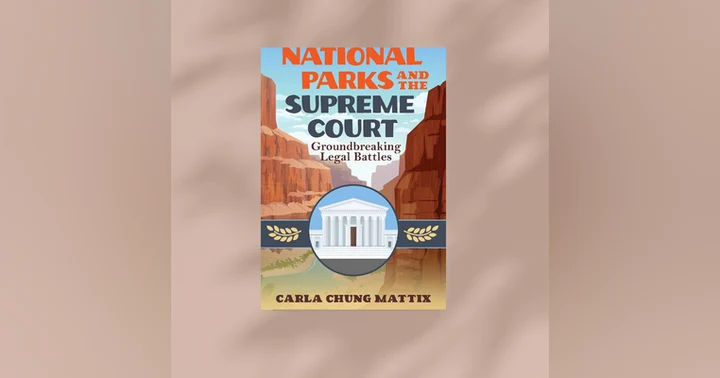
Landmark Decisions: How the Supreme Court Shaped America's National Parks | Carla Chung Mattix

Author and attorney Carla Chung Mattix joins Jennifer Robin Terry to discuss Mattix's new book, National Parks and the Supreme Court: Groundbreaking Legal Battles. They explore Supreme Court cases involving Gettysburg National Military Park, the Grand Canyon, and Yellowstone. They also touch on the ongoing legal dispute surrounding the destruction of the White House East Wing and its potential implications for the National Park Service. From historic battlefields to today's legal disput...


Author and attorney Carla Chung Mattix joins Jennifer Robin Terry to discuss Mattix's new book, National Parks and the Supreme Court: Groundbreaking Legal Battles. They explore Supreme Court cases involving Gettysburg National Military Park, the Grand Canyon, and Yellowstone. They also touch on the ongoing legal dispute surrounding the destruction of the White House East Wing and its potential implications for the National Park Service.
From historic battlefields to today's legal disputes, Mattix reveals how Supreme Court decisions have shaped America's national parks and continue to influence their protection and management.
Featured Guest
Carla Chung Mattix is an author and attorney, formerly with the U.S. Department of the Interior, where she worked in the Office of the Solicitor on legal matters involving the National Park Service. Her work included cultural resource protection and the implementation of the Native American Graves Protection and Repatriation Act (NAGPRA). She is the author of National Parks and the Supreme Court: Groundbreaking Legal Battles, which explores how landmark court decisions have shaped the preservation and management of America's national parks.
She also writes National Parks Legal History, a Substack newsletter examining the connections between historic legal decisions and contemporary issues affecting the national parks.
Buy the Book
Carla Chung Mattix, National Parks and the Supreme Court: Groundbreaking Legal Battles
BONUS: Use my Bookshop.org links to buy the book and you get instant literary cred, while the author, this podcast, and local indie bookshops get actual financial support. It’s the closest thing to ethically justified shopping you’ll do all week.
***************
If you enjoyed this episode…
Subscribe on YouTube
Follow on Instagram, Facebook, or Bluesky
Leave a review here. Reviews and shares make a real difference in helping thoughtful conversations about history reach new audiences.
**History runs on curiosity…and occasionally, caffeine.**
The Clio Dialogues is independently produced. If you'd like to help support future episodes, consider buying me a coffee. Every cup helps keep new conversations coming.
***************
Affiliate Disclosure
Some links in The Clio Dialogues show notes are affiliate links. As a Bookshop.org Affiliate and Amazon Associate, I may earn a small commission on qualifying purchases at no additional cost to you. Those commissions help offset the costs of producing The Clio Dialogues, allowing me to continue bringing historical scholarship to a wider audience. Thank you for your support.
Editorial Independence
The Clio Dialogues supports productive, respectful, freedom of expression. My, or my guests opinions may deviate from each other or from yours -- and that's okay!
We welcome diverse, respectful comments.
Introduction
Host, Jennifer Robin Terry
Hello and welcome to the Clio Dialogues, the podcast that links history with the present to help us better understand the world we live in today. I am your host, Jennifer Robin Terry.
Guest, Carla Chung Mattix
The thing that really surprised me was that the U.S. Attorney was defending the treaty rights of the Shoshone- Bannock. The United States was trying to make the case that the rights to hunt off their reservation on unoccupied lands were still valid. And that to me was a big surprise.
Host, Jennifer Robin Terry
My guest today is author and attorney Carla Chung Maddox. She is the author of National Parks and the Supreme Court, Groundbreaking Legal Battles, published by University of Nevada Press. Welcome, Carla. I am so glad you could join me here on the Clio Dialogues.
Guest, Carla Chung Mattix
Thanks, Jennifer. It's really great to be here. I really appreciate the opportunity.
Lawyers Behind the National Parks
Host, Jennifer Robin Terry
I was really excited to read your book because when we think about the history of the U.S. and the creation of the national parks, we often think about conservationists and preservationists and presidents and Congress and all these people who helped to create the parks. But we don't often think about the role of the courts and how the Supreme Court decisions have shaped what the parks are today. And I suspect that most people who visit the national parks don't give a lot of thought to the legal teams that are working behind the scenes either. I wonder if we could start there. Could you tell us just a little bit about what you did as an attorney for the National Park Service?
Guest, Carla Chung Mattix
Yeah, that is actually one of the reasons why I decided to write this book. I would often get questions from people outside of the Department of Interior. That's where I worked, U.S. Department of the Interior, in the Office of the Solicitor. And I worked in the branch of National Parks with a team of about 12 to 14 attorneys in Washington, D.C. And then we have some attorneys in field offices around the country as well, but a fairly small group. And we only focus on National Park Service issues. When I would tell people at a dinner party or when whenever a question comes up, well, what do you do? And I would say, I'm a National Park Service attorney, I could tell that they were a little bit confused and it wasn't the usual answer when you say you're a lawyer. And they would naturally ask me, what does a Park Service attorney do? Most people know about National Park rangers or interpreters or historians or the people that are the face of the park, but they don't really realize what goes on behind the scenes. And a big part of that is legal. So I would explain to them that first of all, the national parks have been involved in thousands of legal cases over the years. And so we naturally have attorneys to work on those. But in addition to litigation, there are just all kinds of issues that would occur at something like a large corporation. If you think of the Park Service as a large federal bureaucratic corporation, we would have all of the same issues. We have contracts to review, environmental compliance, regulations to write, policies to develop. And attorneys are involved in all of those matters before they get finalized. So there was always plenty of work for my office. And it was really an honor and a privilege to do that work on behalf of the National Park Service and the National Park employees. And I wanted to write about not just the Supreme Court cases and the specific legal issues that came up that shaped the National Park Service over time, but these people that were involved, these public servants that, in my experience, worked very hard and were very dedicated for long careers.
Host, Jennifer Robin Terry
Is there a case that you worked on that particularly stands out in your memory as just really something that you're very proud to have worked on? Yeah, there's probably quite a few.
Guest, Carla Chung Mattix
And one of the areas that I worked on primarily was the area of cultural resources. And the Park Service has both natural resources and cultural resources, very broad categories that things get broken into. Everybody certainly appreciates the natural resource side of parks, the incredible mountains and lakes and oceans and things like that, and the wildlife at parks. But a lot of people aren't as familiar with the cultural resource side, which is the preservation of history, of archaeological resources, Native American stories, these connections to the parks that really bring the history of the parks alive. And that cultural resource side is a very important part of the National Park Service as well. So I was always very proud of the work I did to support those areas. And in particular, when I started in the mid-90s, the Native American Grapes Protection and Repatriation Act had just been passed in 1990. And this was an incredibly important law that required federal agencies and museums to assess the Native American cultural items and human remains in their collections and work through a process to return those materials and human remains back to associated Native American tribes. So my work in developing the regulations to implement that, which the National Park Service was tasked to do under the statute. The Department of Interior was tasked to implement NAGPRA and my work on those regulations and the attempts to implement that statute was really one of the most important things I think I worked on.
Host, Jennifer Robin Terry
So let's
The Birth of the National Park Service
Host, Jennifer Robin Terry
turn to when the National Park Service was established in 1916. It's established with the Organic Act. Can you tell us a little bit about that act?
Guest, Carla Chung Mattix
Yeah, that's right. So even though our first national park was created in 1872, and that was Yellowstone National Park created by Congress, there was no agency for over 30, 40 years to manage national parks. So by 1900, there were only five national parks at that point, and I believe five national military parks had been established at that point. More started to come online after 1900. And at this point, they were being managed by various agencies. Some were managed by the Department of War, which it was called that back in those days. Especially the national military parks were under the jurisdiction of the Department of War. Some of the parks were under the Department of the Interior, but not under any special parks bureau at the time. It was just the Department of the Interior. And some were also starting to be managed by a new National Forest Service. So there were different management agencies and philosophies happening at various national parks. One thing I talk about in my book, Cameron versus the United States, is a case involving Grand Canyon, which was not a national park before 1916, but it did become a national monument in 1908 under the Antiquities Act. It was being managed in this kind of ad hoc manner by the U.S. Forest Service, but also some agencies under the Department of the Interior, such as the General Land Office, the Mining Office was handling some things in the monument. So it really became apparent through this litigation that there needed to be a single agency to actually manage the Grand Canyon National Monument. So that was one of the reasons that convinced Congress to create a national parks agency, which under the 1916 Organic Act, it was called the National Park Service. And that was the birth of the National Park Service.
The Battle for the Grand Canyon
Host, Jennifer Robin Terry
Let's go back to that Cameron case because I think the Grand Canyon would look really different, and tourism to the Grand Canyon would look really different today without that Supreme Court decision. Can you tell us a little more about that?
Guest, Carla Chung Mattix
Yeah, it's probably one of my favorite cases in the book because it has just all of the elements of a great story. It has the Grand Canyon, which everybody loves today, incredible national park. It has a protagonist in Theodore Roosevelt who wanted to protect it and made it into a national monument in 1908. And it has a villain who is Ralph Cameron, who was one of the named persons in the case title. And Ralph Cameron was an entrepreneur. Many people would call him that in his day. And this was in the early 1900s. He actually came to Arizona in the late 1800s to pursue mining claims in the area. And this area was not settled at the time. So he was one of the very early people to come and pursue mining claims around the Grand Canyon. And he filed for mining applications with the Department of the Interior under the 1872 Mining Act. He really staked a lot of claims all around Grand Canyon, areas that are iconic areas of the canyon. On the South Rim, where the El Tovar Hotel is, where the Bright Angel Lodge is, where the Bright Angel Trail down to the river goes. He had mining claims in all of these really critical areas that make up some of the most popular places in the park today. And he was moving forward with these mining claims, but soon realized that mining was not the most lucrative business there. At the time, tourism was beginning to really become a big thing at the Grand Canyon. People were coming there to visit. So he saw the writing on the wall that his mining claim areas might be better suited for tourism areas. And he began to build lodges and he took over the trail down to the river. He created it into a toll road, even though it was technically it was a trail, but back then these types of dirt trails could be toll roads under the state laws. So he charged people to go down this trail. And he had a lot of money-making ventures in the area.
Host, Jennifer Robin Terry
He was quite the entrepreneur.
Guest, Carla Chung Mattix
He was. Yeah. And, you know, he also became very active in early Arizona politics. This was before Arizona became a state. It didn't become a state until 1912. So he was one of the early territorial delegates. So he was very savvy. He became active in local politics, and that helped his causes as well to get permissions to do things. Well, this whole area was owned by the federal government, by the United States in various ways. Even the mining claim areas, Cameron hadn't taken all the steps to what they call patent the claim, which is to basically transfer the title to an individual if they show that they're actually doing mining and producing active, fruitful mining activities. He hadn't taken all those steps. So the Department of the Interior around this time wanted to protect, it was already a monument. It was within a forest reserve, and they wanted to really take steps because they could see that this might become a national park one day. So they started to invalidate Cameron's mining claims. And that's how all of these started to go to court. Some of them went to state court, some of them were in federal court. And eventually some of the federal claims were the ones that ended up at the Supreme Court. So the United States was trying to eject Ralph Cameron from the Grand Canyon and take back his mining claim areas that he was not using for mining, that he was using now for tourist development, and get this area ready to become a national park. It was a really important case because one of the fundamental challenges that Cameron and his attorneys made was that the Grand Canyon should never have been made a national monument in the first place under the Antiquities Act, because he argued that the Antiquities Act was only meant to protect antiquities. And when Theodore Roosevelt created the Grand Canyon National Monument in 1908, he preserved over 800,000 acres for their scientific interests. Not for antiquities, but as an object of historic or scientific interest, which is one of the terms in the Antiquities Act and one of the areas eligible to be protected under the Antiquities Act. So it's not just about antiquities. And Cameron and his attorneys argued that Grand Canyon National Monument should never have been made a national monument because that's not what the Antiquities Act intended. This was one of the issues that went up to the Supreme Court, and the Supreme Court almost summarily said that's not correct. They said, yes, the Grand Canyon is an object of scientific interest. How can it not be? It's the Grand Canyon. Look at this place. You know, he didn't say it like that, the Justice Vandevanter, but he, you know, essentially said, this is an object of scientific interest, and it is eligible under the Antiquities Act to be a national monument. So it was a really fundamental important case to make sure that national monuments could include these vast areas of scientific interest. And I think the thing that's important is, you know, we look at the Grand Canyon, and it is this contiguous area. You can't just carve out one small side canyon. The whole thing is this incredible area that's for geologists and other scientists just really an immense source of research and scientific curiosity. So that I think is the way you would look at it to establish an area of this side for scientific interest. And today we look at things like areas of ecological conservation, corridors, how they're all connected and how wildlife connects to all these various areas. And there's just so many different types of scientific interest involved. And I guess I just want to make one other point about the holding in that case. It's really important because so many of our iconic national parks today started out as national monuments under the Antiquities Act. Places like Zion, Olympic National Parks, so many of these places were originally national monuments. And if they had not been protected initially as national monuments, there might not have been enough left for them to eventually become a national park.
Host, Jennifer Robin Terry
So were there other claims in other places that were withdrawn or forfeited because of the Cameron decision?
Guest, Carla Chung Mattix
Mining claims?
Host, Jennifer Robin Terry
Mining claims, yes.
Guest, Carla Chung Mattix
Not that I'm aware, not that led to a case on the level that went to the Supreme Court. There are continuing attempts, I think, to invalidate mining claims if they're not truly valid, to clear them off the books to make sure that these areas are as conserved as wholly as possible.
Gettysburg and Eminent Domain
Host, Jennifer Robin Terry
The Antiquities Act allows the president to set aside monuments of note. That's one way that some of these national parks come about. Another way that the federal government sometimes acquires land to make into a national park is through eminent domain. Chapter one talks about the Gettysburg Battlefield. Can you tell us a little bit about the Supreme Court case that led to the establishment of Gettysburg?
Guest, Carla Chung Mattix
Yeah, today it's called Gettysburg National Military Park. That case is also very interesting. It's one of the older cases in the book. It's from 1896. And again, this is before there was a National Park Service in 1916. So the Department of War was actually involved in this case. And the federal government was working with veterans to preserve this area about 30 years after the Battle of Gettysburg, which occurred in 1863. Around the same time, there was also an effort to increase tourism in this area. And one of the parties interested in tourism wanted to develop an electric trolley through the battlefield so tourists could easily view all the various battle sites and then maybe have some fun tourist excursions, such as merry-go-rounds and dance halls and casinos, and all on the battlefield area. This did not sit well with the veterans that wanted to preserve this area. It's basically a sacred site and an area to remember their fallen colleagues, because this was a time when many of the veterans were still living and remembered the Civil War very vividly. So the federal government was attempting to create a national park in this area, but they did not own the land. So the areas in the east were very different from areas in the west, such as Yellowstone National Park, which had been carved out of vast areas of public lands. So it was easy to create these areas, even though there's a lot of controversy about how these areas were created because they were originally Native American lands gained through treaties and other means. But the federal government did technically, in a legal sense, own the public lands in the West. So they could create a huge Yellowstone National Park with one sweep of the pen. Congress could just create that park. On the East Coast, most of these lands were in private ownership. The lands at Gettysburg were owned by farmers and other townspeople. So the government could not just come in and create a national park. They had to obtain the land. And the trolley owner had been buying up some of these lands to create his railway. He was causing damage to the areas, damage to the sites. So the government and the veterans wanted this to stop. They wanted to preserve this area and keep it pristine and they wanted to look the way it looked during the battle, basically, or the day before the battle. So the federal government had to use one of the few tools it had to try to protect this area, which is the power of eminent domain. So now this eminent domain goes back to our English roots where a king or sovereign could just take land. But when the concept of eminent domain came into the United States' legal system through the US Constitution, it is qualified. There is a concept of eminent domain, but it must be for a public use. And it also has to be tied to the power in the Constitution. And there has to be just compensation to the entity that the land is being taken from. And the government did try to negotiate with the trolley owner to do a sale of the land. This did not work and ended up going into court. The government brought a condemnation action. They ended up losing in the lower court because the lower court judge did not believe there was a constitutional power that gave the government the ability to take this land for historic preservation reasons. And that was the main reason they wanted to preserve this land. It was to preserve the history of the battle. And that was the issue that ended up going up to the Supreme Court. And the Supreme Court did find powers in the Constitution connected to the Congress's power to establish a military and do lots of different things for military reasons. Just the general notion that liberty and anything connected to the pursuit of happiness is inherent in the good of the people, basically. And so that concept just lives in our constitution. And this was an action that went towards that. So they believed that preserving this area and saving the history was a power that could be used in the pursuit of condemnation proceeding.
Host, Jennifer Robin Terry
Has the federal government used the power of eminent domain very often to acquire land for national parks?
Guest, Carla Chung Mattix
So they actually have, although it has become somewhat controversial over the years. Gettysburg, they ended up using eminent domain to really establish a lot of that area. And it did become a national park. Later, there were parks such as Shenandoah National Park, Everglades, where the government also used eminent domain in those areas. And some of those have a very complicated legacy, especially Shenandoah National Park, where many people were removed from their lands in Appalachia. Really, I mean, it was by force, basically. They were given compensation, all of the procedures were met, but many communities were displaced. This has left a negative feeling towards the park by local communities in the area, and it still exists today. The National Park Service was not the only entity in the government doing these types of actions during the whole dam building era. Communities were being displaced, and Native American tribes were being displaced. So it started to really cause a lot of problems. And in the 70s, there was more attention to finding other ways to achieve goals besides using eminent domain. So the National Park Service, through this entire effort of the US government to veer away from eminent domain, has also incorporated things in its policies to use eminent domain as a last resort to preserve an area. And Congress has even, in some places, said the Park Service may not use eminent domain. At some of the national seashores, they were being developed in the 60s and 70s. There are provisions that say eminent domain may not be used. It definitely is still something in the toolbox, but it's not used just out of regular procedures.
Host, Jennifer Robin Terry
So regarding the seashores, is that where we see sometimes private beaches that are attached to those beachfront homes?
Guest, Carla Chung Mattix
Right. Yeah. So a lot of the seashores, like a Cape Cod National Seashore and some of the other ones, you'll see a lot of inholdings. There are areas where the Park Service may have tried to negotiate a sale, but have not been successful. And so those areas remain private. So it's almost like kind of a hodgepodge checkerboard type situation. Those parks are very difficult to manage. You don't have this one area with the boundary, and the Park Service can implement its rules and regulations inside the boundary easily. Instead, you have this mix of private and federal land. And so those get very difficult to manage.
Host, Jennifer Robin Terry
Maybe a lot of legal intervention in those cases.
Guest, Carla Chung Mattix
Exactly. They keep the lawyers busy.
Native American Treaty Rights
Host, Jennifer Robin Terry
Is there anything that really surprised you, really jumped out at you, made you go, hmm, as you were researching?
Guest, Carla Chung Mattix
Yeah. One of the cases talks about Native American rights and unintended consequences. And that was the concept that came up in the second case in my book, Ward v. Racehorse. That case involved Yellowstone, and it was also in the 1890s and involved a question about the validity of the 1868 treaty with the Bannock Shoshone tribe and whether they could hunt off their reservation in areas adjoining Yellowstone National Park, potentially in Yellowstone National Park and in Wyoming. I just always had referenced this case by its title and its holding without knowing who is Ward or who is Racehorse. And I always kind of thought Ward was just a generic name for somebody that's a dependent of some sort, a ward of the state. And so when I started really looking into this case and who was involved, who were these people, and what was the real issue in the case? The thing that really surprised me was that the U.S. government, the U.S. attorney in Wyoming at the time, and you have to remember this was in the 1890s. Wyoming had just become a state. The U.S. attorney was defending the treaty rights of a specific Native American tribe, the Shoshone-Bannock. And we're trying to make the case against Wyoming, who was the ward in this case, it was Sheriff Ward. And but he was a sheriff in Wyoming. But the United States was trying to make the case that the Native American treaty rights were valid, that the rights to hunt off their reservation on unoccupied lands were still valid. And, you know, the zeal that I read through the letters and correspondence and reports by the U.S. attorney, some of the U.S. Indian agents for the reservation, that's what they were called, Indian agents. They just really believe these treaty rights still existed. That to me was a big surprise. Like I did not realize that the United States was the party trying to defend these treaty rights in that case. Because that, as we know, that time period, much of US policy was trying to assimilate Native Americans into the rest of U.S. culture and really trying to strip away rights. So yeah, I felt I found like that was a very interesting aspect of this case.
Host, Jennifer Robin Terry
Yeah, that is really interesting. It turns on its head what we think we know and complicates it.
Guest, Carla Chung Mattix
Exactly.
Free Speech in National Parks
Host, Jennifer Robin Terry
Your book explores several other fascinating issues, including wildlife protection, the unintended consequences of conservation policies on Native American treaty rights, and the issue of free speech on national park property. One thing that particularly surprised me is that the National Park Service receives thousands of applications a year for demonstrations on the national mall, and relatively few are actually approved. I had no idea.
Guest, Carla Chung Mattix
Yeah, the permit issue in Washington, DC, is really a very complicated issue. I did not personally work on permits or demonstrations, but the colleagues in my office that did were often very busy, especially around times like inauguration. Um, you know, it's when you see these big demonstrations in DC. Most of those green spaces in DC, almost all of them and the memorials, those are managed by the National Park Service. Many people don't realize that. And it keeps the Park Service and the attorneys working on these First Amendment issues very, very busy.
Host, Jennifer Robin Terry
Considering
The White House East Wing Dispute
Host, Jennifer Robin Terry
the legal and political challenges the National Parks face today, what concerns you most?
Guest, Carla Chung Mattix
So today there's more issues facing the National Park Service than I would have ever anticipated. The cases in litigation right now, especially those involving DC area issues, are just really hard to keep track of. One of the cases that has received a lot of attention, and this is a National Park Service case, is the case involving the destruction of the East Wing of the White House and the construction of a new ballroom. So that case was filed as the National Trust for Historic Preservation versus the National Park Service, because the Park Service is the federal agency responsible for this area that the East Wing is in, the area around the White House. President's Park is a specific park unit within the nation's capital. So this is a National Park Service case, and I'm concerned because one of the issues that, if it ever gets to the merits, the case has been in these emergency proceedings, injunctions, those types of preliminary issues where things move pretty fast because plaintiffs are asking actions to stop right away. And so the courts act more quickly, but they don't look at all of what we call the merits of the case, the real substantive issues. They just look at sort of the preliminary emergency type things. And that's where that case is right now. But once they get to the merits of the case, the US government has asserted that it can take actions such as destroying the East Wing with very little process, following very few of the normal environmental processes, historic preservation processes, because it has the discretion to do that under the National Park Service Organic Act. So it's asserting this very wide interpretation of authority under the Organic Act. Even though in many administrations and situations, we want the National Park Service to have a lot of discretion. We want the Park Service employees to be able to use their professional judgment, the career employees, to do what they do, to use their expertise and not have courts second-guess that all the time. But I'm concerned in this case, these actions have seemed to have happened on a broader scope and not just involving National Park Service employees. And yet the government is saying that this is being done under the National Park Service Organic Act. So they should be given wide birth to do these actions. So I'm concerned if this case ever gets to the merits and the courts look at what can or can't the Park Service do under the Organic Act? It could constrict the Organic Act in some way. And that might constrain the Park Service in the future.
Host, Jennifer Robin Terry
That is a significant concern. I also wanted to let our listeners know that you have a Substack newsletter. Is this something that we can follow along and keep us up to date?
Guest, Carla Chung Mattix
Yep, exactly. My Substack is called National Parks Legal History. And I started it specifically to write about some of the current issues going on and how the past legal cases tie into the current legal cases and how those might be decided in the future. But yes, I try to explain it with not too much legal ease. I want everybody to be able to learn about these issues. And I do really feel that the legal history of the national parks is a very important part of the overall history of the parks. And so I want to try to make it accessible to anybody that's interested in that history.
Host, Jennifer Robin Terry
I'll be sure to include a link to the Substack in the show notes so listeners will know where to find you. In closing, what do you hope readers will take away from your book?
Guest, Carla Chung Mattix
I hope that people that are interested in the preservation of our national parks will gain a broader understanding of what goes into shaping our national parks. That it's not just the biologists or wildlife managers or other administrators, but the courts will also play a role that has had a very direct influence on National Park Service policy, and I think it will continue to do so in the future.
Host, Jennifer Robin Terry
To learn more about this and any book featured on the Clio Dialogues, read Clio's book reviews at www.cliodialogues.com. This has been the Clio Dialogues. Please like, follow, and subscribe. And join me again next time because history isn't finished with us.